In addition to a new Photos app and emoji improvements, yesterday's developer release of the first OS X 10.10.3 beta also includes new direct support for Google's 2-Step Verification when setting up Google services in the Internet Accounts section of System Preferences.
2-Step Verification is an optional security setting that requires users to enter not only their account password but also a unique code sent by Google via phone app, text message, or voice call to a previously registered device or phone number, greatly enhancing account security.
Not all devices and apps support Google's 2-Step Verification, however, and as a backup Google also allows users to generate app-specific passwords to register a unique password for that device or app. The app-specific password can be revoked at any time by logging into the user's Google account for another time, making it easy to disable access on a device that has been lost or stolen.
On OS X 10.10.2 and earlier, users setting up their machines to access Google accounts with 2-Step Verification enabled have had to use this app-specific password option. Users trying to log in with their standard Google account passwords are met with error messages informing them they need to use this option.
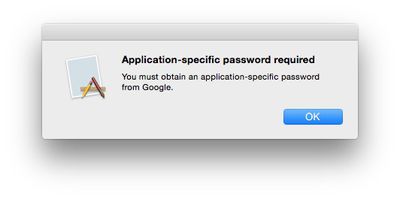
OS X 10.10.2 requiring an app-specific password for a Google account protected with 2-Step Verification
But as noticed by developer Jonathan Wight, the new OS X 10.10.3 beta now fully supports 2-Step Verification, allowing users to log in with their standard passwords and unique verification codes.
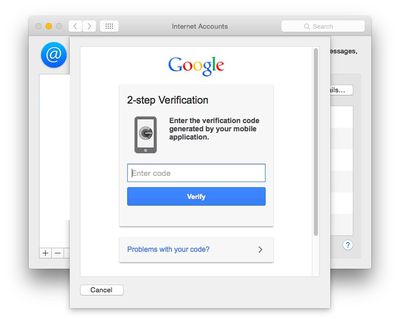
OS X 10.10.3 requesting verification code after logging in with standard password
The change makes logging in with 2-Step protected accounts much simpler and increases security by making sure the user attempting to log in has a secondary trusted device to provide the verification code.
Wednesday February 18, 2026 12:43 pm PST by Joe Rossignol
Apple is looking for a "breakthrough" with its push into wearable AI devices, including an "AirTag-sized pendant," according to Bloomberg's Mark Gurman.
In a report this week, he said the pendant is reminiscent of the failed Humane AI Pin, but it would be an iPhone accessory rather than a standalone product.
The pendant would feature an "always-on" camera and a microphone for Siri voice...
Apple will announce its rumored low-cost MacBook at its event on March 4, with the device coming in a selection of bold color options, according to a known leaker.
Earlier this week, Apple announced a "special Apple Experience" for the media in New York, London, and Shanghai, taking place on March 4, 2026 at 9:00am ET.
Posting on Weibo, the leaker known as "Instant Digital" said that the...
New trade-in data indicates that Apple's iPhone 17 Pro Max has rapidly become the single most traded-in smartphone.
According to a new report from SellCell, Apple's latest flagship iPhone has quickly risen to the top of the independent trade-in market, accounting for 11.5% of all devices appearing in the top-20 trade-in rankings just months after release. The analysis is based on SellCell...
Wednesday February 18, 2026 9:29 am PST by Joe Rossignol
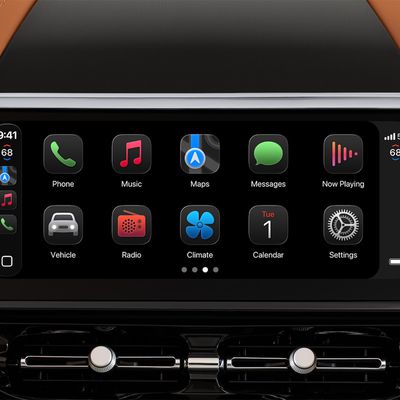
Back at WWDC 2025, Apple revealed that it was planning to allow CarPlay users to watch video via AirPlay in their vehicles while they are not driving, and the first beta of iOS 26.4 suggests the feature may be nearing availability.
There are several new references to CarPlay video streaming functionality within the iOS 26.4 beta's source code. The feature is not yet visible to users, but...
Wednesday February 18, 2026 5:12 am PST by Tim Hardwick
Apple's iPhone development roadmap runs several years into the future and the company is continually working with suppliers on several successive iPhone models at the same time, which is why we often get rumored features months ahead of launch. The iPhone 18 series is no different, and we already have a good idea of what to expect for the iPhone 18 Pro and iPhone 18 Pro Max.
One thing worth...
I have an Apple Airport Extreme router. After my iMac wakes from sleep, I often cannot connect to Wi-Fi, even with OSX 10.10.2. And yet my iPad and iPhone connect perfectly every time. What does this tell you? Apple gets it right with iOS, but they are no longer putting the resources into Macs and OSX. It shouldnt take this many months to get the bugs out of a new OS.
Not to berate you, or knock your complaints... But not sure what this has to do with the article (2-Step Verification)...
The "webpage-inside-a-sheet" look looks pretty lazy, but it is a beta.
I could be wrong but I think it needs to be that way to hand control over to Google to do the authentication. That's the same thing you'll see in any application that supports their 2-factor setup.
The "webpage-inside-a-sheet" look looks pretty lazy, but it is a beta.
I have an Apple Airport Extreme router. After my iMac wakes from sleep, I often cannot connect to Wi-Fi, even with OSX 10.10.2. And yet my iPad and iPhone connect perfectly every time. What does this tell you? Apple gets it right with iOS, but they are no longer putting the resources into Macs and OSX. It shouldn’t take this many months to get the bugs out of a new OS.
It doesn't tell you anything. Everyone has different experiences...for me, iOS 8 is way buggier than OS X, especially Safari.
I have an Apple Airport Extreme router. After my iMac wakes from sleep, I often cannot connect to Wi-Fi, even with OSX 10.10.2. And yet my iPad and iPhone connect perfectly every time. What does this tell you? Apple gets it right with iOS, but they are no longer putting the resources into Macs and OSX. It shouldnt take this many months to get the bugs out of a new OS.