Skip to Content

Apple Supplier Sony Debuts 21-Megapixel Image Sensor With Ultra Fast Autofocus, 4K HDR Video

Sony today announced a new advanced image sensor designed for use in smartphones, which uses a new "stacked" design to cut down on size while introducing improved image quality and faster speeds. Apple uses Sony sensors in its iPhones and iPads, so it is likely that Sony's stacked sensor technology will make it into future iOS devices at some point.

The new 21-megapixel Exmor RS IMX230 sensor is built with a chip that stacks a pixel section and a circuit section on top of one another, which allows Sony to build improvements into each aspect of the sensor individually, leading to dramatic improvements. Sony's been using stacked sensor technology since 2012, but its newest sensor introduces new autofocus and HDR technology.

According to Sony, the IMX230 sensor is the first CMOS sensor for smartphones that includes plane phase detection autofocus signal processing with 192 autofocus points, resulting in much faster tracking of moving subjects that happens almost instantaneously.
192pointautofocus

Image plane phase detection AF function using 192 AF points

The sensor also includes support for full 21-megapixel HDR pictures and 4K HDR video, resulting in better lighting in high-contrast scenes. HDR or High Dynamic Range imaging captures separate images with different exposures, combining them into one image that improves detail and color.

The new IMX230 is a type 1/2.4 stacked CMOS image sensor with a significantly improved 21 effective megapixels, and it is also equipped with a newly developed signal processing function. These features fulfill the growing needs in smartphone photography for high-speed autofocus (image plane phase detection AF) and clear, high-quality capture of bright and dark areas even in backlit scenes (HDR imaging). Image plane phase detection AF is a technology used in mirrorless interchangeable-lens cameras, and HDR imaging now supports not only 4K (4096 x 2160) high-resolution videos but also still images.
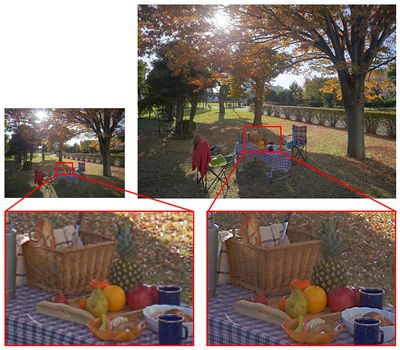
hdrimprovements

HDR video from existing IMX135 sensor with 3.2 effective megapixels on left, IMX230 21-megapixel HDR image using IMX230

Sony is known for making some of the best image sensors available, and Apple has long used Sony sensors in its iOS devices. Sony's new image sensor will begin shipping in April of 2015, and while it is likely the new sensor technology will make its way into Apple's iPhones and iPads, it is unknown when that might occur.

Apple does not typically use high-megapixel sensors in its iPhone or iPad, but Sony is planning on producing a 16-megapixel version of the IMX230 in 2015, which would be appropriate for iOS devices. It's possible Apple could use the 16-megapixel version of the IMX230 in the 2015 iPhone 6s and 6s Plus, but it's also possible that the sensor won't be utilized until 2016 or later as Apple often uses slightly older sensors in its devices.

Tom's Hardware believes that the next-generation iPhone 6 and 6 Plus may incorporate either the upcoming 16-megapixel IMX240 sensor from Sony or the 13-megapixel IMX135, which Sony first introduced in January of 2013.

It's not known exactly which sensor is used in the current iPhone and iPad, but camera experts have speculated that the iPhone 6 and 6 Plus use the Sony ISX014 sensor, an 8-megapixel sensor that Sony first introduced in October of 2012.


Popular Stories

iOS 27 Mock Quick

iOS 27 Will Reportedly Be Like Mac OS X Snow Leopard

Sunday March 15, 2026 9:42 am PDT by
In his Power On newsletter today, Bloomberg's Mark Gurman reiterated that iOS 27 will be similar to 2009's Mac OS X Snow Leopard, in the sense that one of Apple's biggest priorities is bug fixes for improved performance and stability. During WWDC 2008's State of the Union, Apple showed a slide that said Mac OS X Snow Leopard had "0 new features," as it opted to focus on performance and...
AirPods Max 2 Feature

Apple Announces AirPods Max 2 With H2 Chip and More

Monday March 16, 2026 6:12 am PDT by
Apple today unveiled AirPods Max 2, with key upgrades including the H2 chip, increased active noise cancellation, improved sound quality, and features such as Adaptive Audio, Conversation Awareness, Voice Isolation, and Live Translation. The new AirPods Max have the same overall design as the previous generation, with most of the new features coming from the upgrade to the H2 chip:- Adaptive ...
Apple Logo Sketch Feature

Apple Unveiled a Surprise New Product Today

Monday March 16, 2026 10:50 am PDT by
Surprise! Apple today unveiled the AirPods Max 2, despite no rumors suggesting that a new version of Apple's over-ear headphones were imminent. Key upgrades compared to the previous AirPods Max include Apple's H2 chip, increased active noise cancellation, improved sound quality, and features such as Adaptive Audio, Conversation Awareness, Voice Isolation, and Live Translation. AirPods Max ...

Top Rated Comments

Jack Delgado Avatar
148 months ago
This means we can go EVEN THINNER
and still have a protruding lens
but THINNER
Score: 29 Votes (Like | Disagree)
gavroche Avatar
148 months ago
Megapixels matter far less to me than sensor size, and light sensitivity.
Say hello to 10-20mb image file sizes! :D
Score: 17 Votes (Like | Disagree)
X5-452 Avatar
148 months ago
At 16 or 21 MP images, Apple better have some sort of 256GB iPhone / iPad model somewhere in R&D to ensure there is enough space on the devices for those file sizes!
Score: 12 Votes (Like | Disagree)
AppleWarMachine Avatar
148 months ago
Yes, I want 4k video on a 16GB iPhone...not :eek:
Score: 11 Votes (Like | Disagree)
148 months ago
This means we can go EVEN THINNER
and still have a protruding lens
but THINNER

It just means people can troll harder.
Score: 8 Votes (Like | Disagree)
Wuiffi Avatar
148 months ago
There are a few things everyone should know before talking about image sensors (especially in smartphones)
1. More Megapixels in smartphones (due to a very small pixel pitch) actually means a worse SNR (signal to noise ratio) than less megapixels, resulting in an overall worse image. This is due to wiring and other stuff "getting in the way" of the photons (And this can NOT be corrected by Downscaling)

2. The sensor it not the only important thing when it comes to image quality, you have to consider the whole image pipeline, optics, ISP etc

3. The size of a camera module depends on the sensor size and the focal length.
Wait, actually this is no longer important, now that we have a protruding camera. So Apple, give me a 1/2.4" or better 1.1.7" sensor :D

What I personally would like to see (maybe not 2015 but soon)
* bigger (1/2.4") sensor
* curved sensor with an alternative color layout (similar to Foveon or Sonys new patented color shift layer)
* 9-10MP (4k need about 8.4 MP and then people finally shut up about it ^^)
* other improvements in sensor technology
Score: 7 Votes (Like | Disagree)