Manipulation of Apple's Stock Price Evident in the Options Market?

Fortune reports on an interesting phenomenon being observed in Apple's stock price related to the weekly options market, the trading of rights to purchase stock at a given price at the end of a specified period. According to the report, Apple's stock is consistently seeing suspicious price changes on Fridays as those options are set to expire, activity that makes a significant of traders lose any potential gains as the stock price moves to meet the strike price for that week's options. In many cases, that activity serves to depress the overall stock price, thereby also negatively impacting regular traders as well.
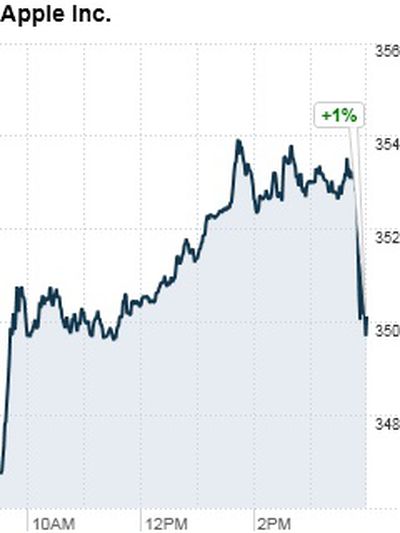
It was 3:48 p.m. on Friday April 29 and traders who had purchased Apple (AAPL) April 29 $350 "calls" -- options that gave them the right to buy Apple shares in blocks of 100 for $350 per share -- were sitting pretty. The stock was trading around $353.50 and those calls were worth more [than] $350 apiece (the difference between the price of the stock and the so-called "strike price" of the option times 100).
Then, in an extraordinary burst of trading -- exacerbated by the rebalancing of the NASDAQ-100 scheduled for the following Monday -- more than 15 million shares changed hands and the stock dropped below the $350 strike price just before the closing bell. Result: The value of those calls disappeared like a puff of smoke.
While the phenomenon is not new and not unique to Apple, the reasons for it are not entirely clear. Some have argued that normal hedging activity is responsible for the drifts in stock price, but scientific studies have shown that such stock price behavior would not be accounted for by simple hedging and is thus indicative of stock price manipulation, which is illegal under U.S. securities law.
Apple is obviously one of the most closely watched stocks these days, and with the second-largest market capitalization in the U.S. markets has the potential to significantly influence trading. And so an apparently consistent manipulation of Apple's stock price makes for an interesting story, even if it is not yet clear who is responsible for the activity and how it is being accomplished.

Top Rated Comments
(View all)Not the Options thing. Not again... :rolleyes:
Oh, Apple, learn how to play nicely in the Stock Market.
What are you talking about? If you didn't read the article why comment?
It's about stock traders manipulating the market. Not Apple "playing nicely."
The market manipulating dirtbags in the minute-by-minute trading game make it difficult for those of us investing the old-fashioned (honest) way. :mad:
Traders (as opposed to those using options for legitimate hedging reasons) don't want to hold options to expiration. If a near-the-money call option is looking like it is going to expire with a value of, say, $1, then the holder of those options is going to sell them. Ultimately, they are going to be involved in a conversion, where the buyer exercises the call (acquiring the stock at the fixed, option price) and then immediately sells the stock. Of course this sale is going to help depress the stock price.
Expiring puts that are in the money are going to help force the stock price up.
The two opposing forces will try to force the stock price to the "max pain" price, which will depend of the overall balance of open calls/puts.
The only fix that I can think of is continuous expiration, rather than a fixed weekly expiration day. Wasn't aware that options went to weekly expiration, and assume that this was meant as a move toward continuous expiration which perhaps back-fired, because it now creates the phenomena weekly rather than monthly.
It's normal *trading* activity, not normal *hedging* activity that is going to force the price to max pain. Hedgers hold options to expiration. Traders don't. The extent to which max pain comes into play will in part be determined by how many options are held by traders as opposed to hedgers.
This alone would fully explain the behavior of the stock price.
Only for 1 of the 8 days analyzed. When something happens too many times in a row, the odds that it is some random effect get much smaller.

What happened to long-term investing in companies you believe in?
That is SO last millisecond.

http://www.lrb.co.uk/2011/05/19/donald-mackenzie/how-to-make-money-in-microseconds
What happened to long-term investing in companies you believe in?
The market manipulating dirtbags in the minute-by-minute trading game make it difficult for those of us investing the old-fashioned (honest) way. :mad:

Unfortunately the old dot com style of day trading never fully died.
Day traders with good cash reserves can make the market have a heart attack if they touch the right stock(s).
The hard part is finding the right stock at the right time.
Looks like someone figured out AAPL's cycle and decided to have some fun with it.
Second, the author mentions the NASDAQ rebalancing, but only in passing. In reality, there were tens of millions of Apple shares (perhaps scores of millions) that needed to be sold by indexed funds in order to match the rebalancing that took place the very next session!! (2 May) This alone would fully explain the behavior of the stock price. Managers saw that the price was strong during the day, so they waited for the last minute to dump what they had no choice but to do.
[ Read All Comments ]

As noted by ifoAppleStore, Apple is continuing its trickle of retail store openings this week with a new location opening on Friday, May 25 in Paris. The new Les Quatre Temps store will be...
TiVo owners can control their devices via an iOS app on the iPhone and iPad, but -- for the moment -- can only watch shows on their television.
But that's all going to change in a few months....
Binary Nights has dropped the price of its file-transfer app ForkLift to $0.99, down from $29.99, for a limited time.
ForkLift is a well-reviewed file management app that offers FTP, SFTP,...