iPhone 13 Lineup Expected to Use Qualcomm's Snapdragon X60 Modem With Several 5G Improvements
Apple's next-generation iPhone 13 lineup will use Qualcomm's Snapdragon X60 5G modem, with Samsung to handle manufacturing of the chip, according to DigiTimes.
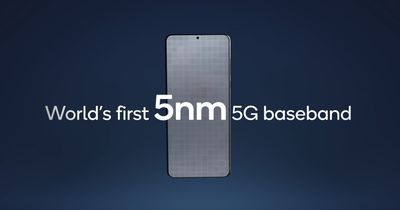
Built on a 5nm process, the X60 packs higher power efficiency into a smaller footprint compared to the 7nm-based Snapdragon X55 modem used in iPhone 12 models, which could contribute to longer battery life. With the X60 modem, iPhone 13 models would also be able to aggregate 5G data from both mmWave and sub-6GHz bands simultaneously to achieve an optimal combination of high-speed and low-latency network coverage.
mmWave is a set of 5G frequencies that promise ultra-fast speeds at short distances, making it best suited for dense urban areas. By comparison, sub-6GHz 5G is generally slower than mmWave, but the signals travel further, better serving suburban and rural areas. mmWave support on iPhone 12 models is limited to the United States, but rumors suggest that iPhone 13 models may support mmWave in additional countries.
In 2019, Apple and Qualcomm settled a legal battle and reached a multiyear chipset supply agreement, paving the way for Apple to use Qualcomm's 5G modems. A court document from the settlement revealed that Apple would likely use the X60 modem for 2021 iPhones, followed by the recently announced Snapdragon X65 modem in 2022 iPhones.
The X65 is the world's first 10 Gigabit 5G modem and antenna system for smartphones, enabling theoretical data speeds up to 10 gigabits per second. While real-world download speeds will certainly be slower than that, the X65 has many other benefits, including improved power efficiency, enhanced coverage for both mmWave and sub-6 GHz bands, and support for all global commercialized mmWave frequencies.
Starting in 2023, Apple is expected to start using its own in-house 5G modems for iPhones.
Popular Stories
Apple is planning to launch new MacBook Pro models as soon as early March, but if you can, this is one generation you should skip because there's something much better in the works.
We're waiting on 14-inch and 16-inch MacBook Pro models with M5 Pro and M5 Max chips, with few changes other than the processor upgrade. There won't be any tweaks to the design or the display, but later this...
Wednesday February 11, 2026 10:07 am PST by
Juli CloverApple today released iOS 26.3 and iPadOS 26.3, the latest updates to the iOS 26 and iPadOS 26 operating systems that came out in September. The new software comes almost two months after Apple released iOS 26.2 and iPadOS 26.2.
The new software can be downloaded on eligible iPhones and iPads over-the-air by going to Settings > General > Software Update.
According to Apple's release notes, ...
It has been a slow start to 2026 for Apple product launches, with only a new AirTag and a special Apple Watch band released so far. We are still waiting for MacBook Pro models with M5 Pro and M5 Max chips, the iPhone 17e, a lower-cost MacBook with an iPhone chip, long-rumored updates to the Apple TV and HomePod mini, and much more.
Apple is expected to release/update the following products...
Apple plans to announce the iPhone 17e on Thursday, February 19, according to Macwelt, the German equivalent of Macworld.
The report said the iPhone 17e will be announced in a press release on the Apple Newsroom website, so do not expect an event for this device specifically.
The iPhone 17e will be a spec-bumped successor to the iPhone 16e. Rumors claim the device will have four key...
Apple acquired Canadian graph database company Kuzu last year, it has emerged.
The acquisition, spotted by AppleInsider, was completed in October 2025 for an undisclosed sum. The company's website was subsequently taken down and its Github repository was archived, as is commonplace for Apple acquisitions.
Kuzu was "an embedded graph database built for query speed, scalability, and easy of ...