Researchers Discover Vulnerabilities in PGP/GPG Email Encryption Plugins, Users Advised to Avoid for Now

A warning has been issued by European security researchers about critical vulnerabilities discovered in PGP/GPG and S/MIME email encryption software that could reveal the plaintext of encrypted emails, including encrypted messages sent in the past.
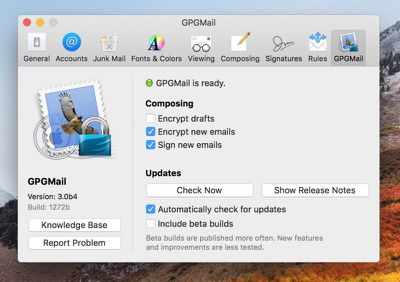
GPGMail pane
The alert was put out late on Sunday night by professor of computer security Sebastian Schinzel. A joint research paper, due to be published tomorrow at 07:00 a.m. UTC (3:00 a.m. Eastern Time, 12:00 am Pacific) promises to offer a thorough explanation of the vulnerabilities, for which there are currently no reliable fixes.


Details remain vague about the so-called "Efail" exploit, but it appears to involve an attack vector on the encryption implementation in the client software as it processes HTML, rather than a vulnerability in the encryption method itself. A blog post published late Sunday night by the Electronic Frontier Foundation said:

"EFF has been in communication with the research team, and can confirm that these vulnerabilities pose an immediate risk to those using these tools for email communication, including the potential exposure of the contents of past messages."

In the meantime, users of PGP/GPG and S/MIME are being advised to immediately disable and/or uninstall tools that automatically decrypt PGP-encrypted email, and seek alternative end-to-end encrypted channels such as Signal to send and receive sensitive content.

Update: The GPGTools/GPGMail team has posted a temporary workaround against the vulnerability, while MacRumors has compiled a separate guide to removing the popular open source plugin for Apple Mail until a fix for the vulnerability is released. Other popular affected clients include Mozilla Thunderbird with Enigmail and Microsoft Outlook with GPG4win. Click the links for EFF's uninstall steps.
Popular Stories

Aston Martin CarPlay Ultra Screen

Apple's CarPlay Ultra to Expand to These Vehicle Brands Later This Year

Sunday February 1, 2026 10:08 am PST by
Last year, Apple launched CarPlay Ultra, the long-awaited next-generation version of its CarPlay software system for vehicles. Nearly nine months later, CarPlay Ultra is still limited to Aston Martin's latest luxury vehicles, but that should change fairly soon. In May 2025, Apple said many other vehicle brands planned to offer CarPlay Ultra, including Hyundai, Kia, and Genesis. In his Powe...

Apple Logo Black

Apple Just Made Its Second-Biggest Acquisition Ever After Beats

Thursday January 29, 2026 10:07 am PST by
Apple today confirmed to Reuters that it has acquired Q.ai, an Israeli startup that is working on artificial intelligence technology for audio. Apple paid close to $2 billion for Q.ai, according to sources cited by the Financial Times. That would make this Apple's second-biggest acquisition ever, after it paid $3 billion for the popular headphone and audio brand Beats in 2014. Q.ai has...
14 inch MacBook Pro Keyboard

Apple Changes How You Order a Mac

Saturday January 31, 2026 10:51 am PST by
Apple recently updated its online store with a new ordering process for Macs, including the MacBook Air, MacBook Pro, iMac, Mac mini, Mac Studio, and Mac Pro. There used to be a handful of standard configurations available for each Mac, but now you must configure a Mac entirely from scratch on a feature-by-feature basis. In other words, ordering a new Mac now works much like ordering an...
Apple Logo Black

Apple's Next Launch is 'Imminent'

Sunday February 1, 2026 12:31 pm PST by
The calendar has turned to February, and a new report indicates that Apple's next product launch is "imminent," in the form of new MacBook Pro models. "All signs point to an imminent launch of next-generation MacBook Pros that retain the current form factor but deliver faster chips," Bloomberg's Mark Gurman said on Sunday. "I'm told the new models — code-named J714 and J716 — are slated...
Apple MacBook Pro M4 hero

New MacBook Pros Reportedly Launching Alongside macOS 26.3

Sunday February 1, 2026 5:42 am PST by
Apple is planning to launch new MacBook Pro models with M5 Pro and M5 Max chips alongside macOS 26.3, according to Bloomberg's Mark Gurman. "Apple's faster MacBook Pros are planned for the macOS 26.3 release cycle," wrote Gurman, in his Power On newsletter today. "I'm told the new models — code-named J714 and J716 — are slated for the macOS 26.3 software cycle, which runs from...

Top Rated Comments

flyinmac Avatar
101 months ago
Hmm.... security protocol creates a vulnerability. To protect yourself, stop encrypting your emails???

Interesting.
Score: 12 Votes (Like | Disagree)
arekm Avatar
101 months ago
This looks like another clickbait by (almost pseudo) research teams. The problem is within mail software and not PGP encryption standard or tools.

https://lists.gnupg.org/pipermail/gnupg-users/2018-May/060315.html
Score: 7 Votes (Like | Disagree)
rodpascoe Avatar
101 months ago
Oh the irony.
Score: 6 Votes (Like | Disagree)
flyinmac Avatar
101 months ago
Hope the alert was not sent by email LOL
Going back to using birds to deliver my messages. Considered pigeons... but I want a bird that can shred anyone who tries to intercept my message. Decided on Hawks.
Score: 4 Votes (Like | Disagree)
Detektiv-Pinky Avatar
101 months ago

<snip>
From what I've read, it's a bug in PGP, not mail
I heard differently. It is supposedly a bug affecting any kind of Email encryption using MIME and automatically loading remote content. Also the in-build S/MIME encryption is at risk.
Score: 3 Votes (Like | Disagree)
belvdr Avatar
101 months ago
From what I've read, it's a bug in PGP, not mail
It's a problem in the mail user agent (MUA), not PGP/GPG. From the mailing list:

https://lists.gnupg.org/pipermail/gnupg-users/2018-May/060315.html


The topic of that paper is that HTML is used as a back channel to create an oracle for modified encrypted mails. It is long known that HTML mails and in particular external links like <img href="tla.org/TAG"/> are evil if the MUA actually honors them (which many meanwhile seem to do again; see all these newsletters). Due to broken MIME parsers a bunch of MUAs seem to concatenate decrypted HTML mime parts which makes it easy to plant such HTML snippets.

There are two ways to mitigate this attack

- Don't use HTML mails. Or if you really need to read them use a
proper MIME parser and disallow any access to external links.

- Use authenticated encryption.
It also appears that some versions of OpenPGP already use authenticated encryption. From what I'm reading, this is a really old bug that many wanted to get fixed, but the MUAs fail to fix it.
Score: 3 Votes (Like | Disagree)