Developer Sees Quick Adoption of iOS 5.1 Amongst Users
iOS developer David Smith has been posting iOS version stats for his Universal app Audiobooks [Direct Link]. Smith gets about 100,000 weekly downloads to both his paid and free versions and believes it is a statistically meaningful data set.
With the launch of iOS 5.1 on March 7th, 2012, Smith has been tracking the adoption rate which he suspected would be faster than in the past due to the availability of over the air (OTA) iOS updates. Indeed, after only 5 days after its initial release, Smith found that 50% of his OTA-eligible customers were already at iOS 5.1. Now, after 15 days, he's found that 77% of OTA-eligible iOS customers have upgraded to the latest version.
When he backs out to include all versions of iOS, including versions such as iOS 3 and iOS 4 which don't offer OTA updates, he finds total adoption at 61% in 15 days.
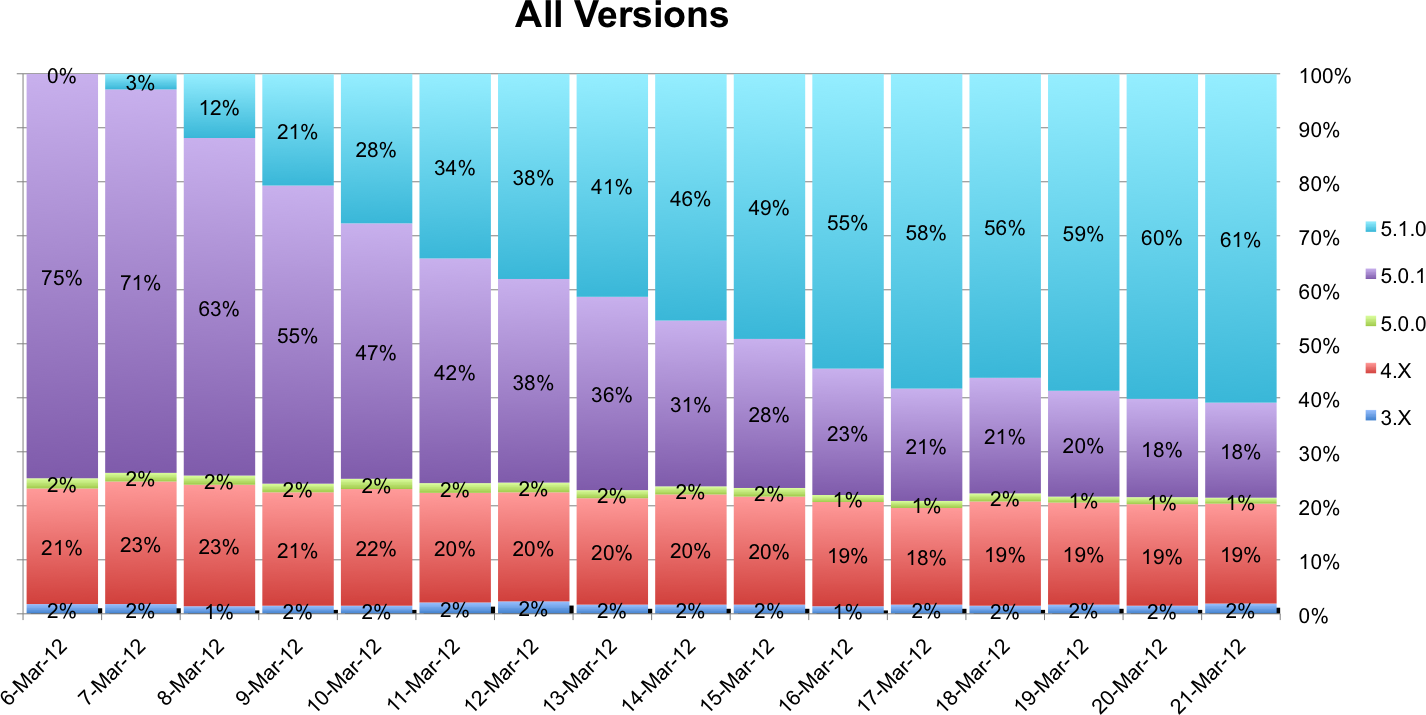
This seems to represent a significant boost in adoption for OTA-eligible upgraders.
While we don't have directly comparable numbers, it took iOS 4.0 one month to hit 50% usage by web traffic. Unfortunately, the numbers aren't entirely interchangeable, as there they are from different data sets (app usage vs web usage), but gives you an idea of the scale. If anything, factors should have contributed to a faster uptake for iOS 4 than would have been expected as it was a major new feature release (vs 5.1) at the time and was included in the successful iPhone 4 launch.
As Smith points out, this is the same level of adoption Android currently sees for Gingerbread (v2.3) which was launched much earlier (mid/late 2011). Meanwhile, the latest version of Android (Ice Cream Sandwidth/v4.0) is only at ~1.6% adoption after about 5 months.
Apple introduced "over-the-air" iOS updates as of iOS 5.0 -- allowing users to upgrade without connecting their device to a computer. They've since deployed two different upgrades (5.01 and 5.1) to users.
Popular Stories
Apple today shared an ad that shows how the upgraded Center Stage front camera on the latest iPhones improves the process of taking a group selfie.
"Watch how the new front facing camera on iPhone 17 Pro takes group selfies that automatically expand and rotate as more people come into frame," says Apple. While the ad is focused on the iPhone 17 Pro and iPhone 17 Pro Max, the regular iPhone...
Apple is planning to launch new MacBook Pro models as soon as early March, but if you can, this is one generation you should skip because there's something much better in the works.
We're waiting on 14-inch and 16-inch MacBook Pro models with M5 Pro and M5 Max chips, with few changes other than the processor upgrade. There won't be any tweaks to the design or the display, but later this...
Wednesday February 11, 2026 10:07 am PST by
Juli CloverApple today released iOS 26.3 and iPadOS 26.3, the latest updates to the iOS 26 and iPadOS 26 operating systems that came out in September. The new software comes almost two months after Apple released iOS 26.2 and iPadOS 26.2.
The new software can be downloaded on eligible iPhones and iPads over-the-air by going to Settings > General > Software Update.
According to Apple's release notes, ...
In select U.S. states, residents can add their driver's license or state ID to the Apple Wallet app on the iPhone and Apple Watch, and then use it to display proof of identity or age at select airports and businesses, and in select apps.
The feature is currently available in 13 U.S. states and Puerto Rico, and it is expected to launch in at least seven more in the future.
To set up the...
It has been a slow start to 2026 for Apple product launches, with only a new AirTag and a special Apple Watch band released so far. We are still waiting for MacBook Pro models with M5 Pro and M5 Max chips, the iPhone 17e, a lower-cost MacBook with an iPhone chip, long-rumored updates to the Apple TV and HomePod mini, and much more.
Apple is expected to release/update the following products...