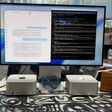
A Spymac thread posted this weekend reveals some screenshots and information about a feature of the new PowerMac G5's called "Slewing".
The feature is located in the Energy Saver Control Panel and allows the user to make some modifications to the Processor and Bus performance settings. A concept that is familiar to laptop owners... the G5 can be run in Reduced, Highest and Automatic performance settings.
Details on the various modes are provided in Apple's Developer Documentation.
To lower power consumption, heat generation, and fan noise, the Power Mac G5 computer incorporates an automatic power management technique called bus slewing. Bus slewing is designed to run at high processor and bus speeds and high voltage when the demand on the processor is high, and to run at low processor and bus speeds and low voltage when the demand on the processor is low.
Speed ranges involved start from 1.3GHz up to the highest rated GHz of the chip (1.6, 1.8, or 2.0). The default slewing option for the PowerMac G5s is Automatic, and the processor and bus speeds are modulated seamlessly to the user.
According to our contacts, there should be no performance loss in Automatic mode.
That being said, at least one user (in the previously mentioned thread) claims an 11 point increase in their Xbench score after changing their Slewing mode from Automatic to Highest. However, readers are reminded that XBench has been inconsistent in producing reproducible benchmark numbers -- even on the same machine. MacRumors' reader 1stunna managed to get a 11 point increase in Xbench scores by simply rerunning the test three times, with no other changes to the system. Whether this represents test-to-test variability or a side-effect of the processor automatically ramping up is still up for debate.
Update: More details found in this Ars Thread:
- The ramp time up or down is ~1ms, but the CPU is running normally during this time, so there is no performance "hiccup". This results in about 60% power/heat savings, which jumps up to about 85% savings if the machine is idle and they "turn on other power saving features". When idle, the CPU fans are barely turning.