Apple Determines iTunes Match Royalties By Counting How Many Times A Song is Accessed
TuneCore president Jeff Price today wrote a blog post praising Apple's iTunes Match service for creating money "out of thin air" for copyright holders. iTunes Match launched with all the major record labels on board, but some small labels refused to participate over concerns the service was legitimizing music pirates.
Price disagrees:
A person has a song on her computer hard drive. She clicks on the song and plays it. No one is getting paid. The same person pays iTunes $25 for iMatch. She now clicks on the same song and plays it through her iMatch service. Copyright holders get paid.
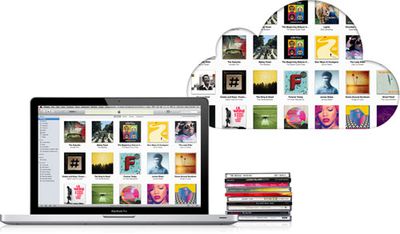
Price tells MacRumors that Apple keeps 30% of iTunes Match revenues for itself -- the same percentage the company keeps from the iTunes and App Stores. The remaining 70% is divided, with 88% going to record labels and 12% going to songwriters. The royalties are split amongst artists based on "how many times someone accesses your song" via iTunes Match and it doesn't matter if a song is matched or uploaded -- the royalty is paid either way.
Price and other record industry execs are thrilled with the iTunes Match service, and by extension, Apple. Not only are artists finally getting paid something for pirated music, but for legitimate song purchases they are getting paid twice. If a listener purchases a CD, rips it to their computer, and then uploads it to iTunes Match, the record company books revenue for both the purchase and the small cut they receive from iTunes Match.
Regarding other music services, Price says, Pandora or Spotify customers are "paying a fee to listen to Spotify's music collection." iTunes Match customers are "paying a fee to have access to [their] own music collection."

Popular Stories
Apple is planning to launch new MacBook Pro models as soon as early March, but if you can, this is one generation you should skip because there's something much better in the works.
We're waiting on 14-inch and 16-inch MacBook Pro models with M5 Pro and M5 Max chips, with few changes other than the processor upgrade. There won't be any tweaks to the design or the display, but later this...
Wednesday February 11, 2026 10:07 am PST by
Juli CloverApple today released iOS 26.3 and iPadOS 26.3, the latest updates to the iOS 26 and iPadOS 26 operating systems that came out in September. The new software comes almost two months after Apple released iOS 26.2 and iPadOS 26.2.
The new software can be downloaded on eligible iPhones and iPads over-the-air by going to Settings > General > Software Update.
According to Apple's release notes, ...
It has been a slow start to 2026 for Apple product launches, with only a new AirTag and a special Apple Watch band released so far. We are still waiting for MacBook Pro models with M5 Pro and M5 Max chips, the iPhone 17e, a lower-cost MacBook with an iPhone chip, long-rumored updates to the Apple TV and HomePod mini, and much more.
Apple is expected to release/update the following products...
Apple plans to announce the iPhone 17e on Thursday, February 19, according to Macwelt, the German equivalent of Macworld.
The report said the iPhone 17e will be announced in a press release on the Apple Newsroom website, so do not expect an event for this device specifically.
The iPhone 17e will be a spec-bumped successor to the iPhone 16e. Rumors claim the device will have four key...
Apple acquired Canadian graph database company Kuzu last year, it has emerged.
The acquisition, spotted by AppleInsider, was completed in October 2025 for an undisclosed sum. The company's website was subsequently taken down and its Github repository was archived, as is commonplace for Apple acquisitions.
Kuzu was "an embedded graph database built for query speed, scalability, and easy of ...