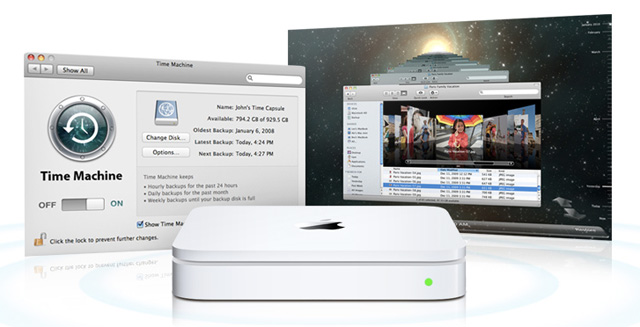
AppleInsider claims that Apple is planning on incorporating support for the new faster 802.11ac Wi-Fi specification into products this year.
The new 802.11ac standard achieves much faster wireless networking speeds than the existing 802.11n specification (in use on the latest Mac, AirPort and iOS devices) by using 2 to 4 times the frequency bandwidth (from 80 to 160MHz), more efficient data transfers through sophisticated modulation, and more antennas (up to 8; existing standards support up to 4, while Apple's Macs currently use up to 3).
This "Gigabit WiFi" offers speeds 3 times as fast as existing 802.11n wireless networks can with speeds of over 1 Gigabit per second.
Despite the specification not being finalized, Broadcom has already announced a family of chips supporting 802.11ac Wi-Fi. The final specification is expected to be certified in the second half of this year.
Apple and other manufacturers have been known to deploy un-finalized wireless technology in the past. Apple deployed 802.11n in new AirPort base stations years before the official standard certification.
Thursday September 17, 2026 4:17 am PDT by Tim Hardwick
In iOS 27, available now, CarPlay gets its biggest update in years, but some features depend on what type of car you have rather than your iPhone model. Some of the biggest additions won't do anything in the vast majority of vehicles on the road today. Here's how the new features pan out.
Works in Any CarPlay Vehicle
Custom widgets: In iOS 27, CarPlay is no longer limited to Apple's handful ...
Wednesday September 16, 2026 8:53 am PDT by Joe Rossignol
The new Apple Watch Series 12 and Apple Watch Ultra 4 have hardware changes that allow for faster charging, but you will need to use the new version of the Apple Watch Magnetic Fast Charger included in the box in order to achieve this boost. If you need extra ones for your own charging stands or travel or so forth, Apple released the new version of the charger on its online store last week, with...
Wednesday September 16, 2026 1:32 pm PDT by Juli Clover
The iOS 27.2 beta that Apple released today adds a feature that reminds you it's your anniversary when you call someone, as long as you've added the date in the Contacts app.
On the date of your anniversary, when you go to call the person, you'll see a reminder that it's an important day so you don't forget to say something. The anniversary alert uses Call Context, a feature Apple added in...
Will this standard support the bandwidth capable of wireless video mirroring of a hypothetical retina iPad 3 using a hypothetical Apple TV 3?
Another thingis it too much to ask that the numbering system for these standards go a, b, c, d, e instead of a, b, g, n, ac? Because in 15 years well end up with something stupid like 802.11no.
I know people like my grandma will ask is n newer than ac?
And another thingI wish USB updated this often. Make everything backwards compatible like it is now but just update the speed every few years instead of waiting. Then most computers today would have at least a fairly speedy USB port compared to 2.0.
How will this work in congested wifi signal areas?
It is bad enough maintaining a clean signal when my neighbours use 40MHz, let alone 80 to 160MHz
In actual fact. the 5GHZ band takes you AWAY from congestion. The 2.4 band is where the interference is at present. My TC operating at 5GHZ and 2.4 (it auto switches) gives a far better connection on my IOS devices than the older standard ever could.
I hope that the speed can be promoted up to 10 Gb/s very soon. Then, a computer display, such as an Apple Thunderbolt Display with WIFI capability, can be connected to a desktop computer, such as a Mac Pro or a Mac mini, through WIFI, which will be the beginning of a new computing era.
WiDi does just this, it's Intel's implementation of the WirelessHD protocol (60 Ghz or if you will, IEEE what 802.11ad will define under the umbrella of WiGig, a competitor of WirelessHD).
On-topic : It will be nice to get a bump up from 802.11n, but frankly wireless is abysmal regardless and reaching the theoritcal top speeds is never easy, even standing next to the base stations. I do get a giggle in these threads when the uninitiated though think we can't really do stuff like stream "1080p full HD" without these advances. 1080p streams just fun already over 802.11n, it's not a matter of pixels but of compression and bitrates.
----------
The 802.11 standards set implements wireless technologies in a set of frequencies. Each of the letters you see after '802.11' count up alphabetically from the first incarnation of the standard. 'a' and 'b' you're familiar with, 'c' to 'f' and 'h' to 'k' cover other standards that the 802.11 group have created to work with wireless LANs.
Just to further drive the point home :
IEEE 802.11a: 54 Mbit/s, 5 GHz standard (1999, shipping products in 2001) IEEE 802.11b: Enhancements to 802.11 to support 5.5 and 11 Mbit/s (1999) IEEE 802.11c: Bridge operation procedures; included in the IEEE 802.1D standard (2001) IEEE 802.11d: International (country-to-country) roaming extensions (2001) IEEE 802.11e: Enhancements: QoS, including packet bursting (2005) IEEE 802.11F: Inter-Access Point Protocol (2003) Withdrawn February 2006 IEEE 802.11g: 54 Mbit/s, 2.4 GHz standard (backwards compatible with b) (2003) IEEE 802.11h: Spectrum Managed 802.11a (5 GHz) for European compatibility (2004) IEEE 802.11i: Enhanced security (2004) IEEE 802.11j: Extensions for Japan (2004) IEEE 802.11-2007: A new release of the standard that includes amendments a, b, d, e, g, h, i & j. (July 2007) IEEE 802.11k: Radio resource measurement enhancements (2008) IEEE 802.11n: Higher throughput improvements using MIMO (multiple input, multiple output antennas) (September 2009) IEEE 802.11p: WAVE—Wireless Access for the Vehicular Environment (such as ambulances and passenger cars) (July 2010) IEEE 802.11r: Fast BSS transition (FT) (2008) IEEE 802.11s: Mesh Networking, Extended Service Set (ESS) (July 2011) IEEE 802.11T: Wireless Performance Prediction (WPP)—test methods and metrics Recommendation cancelled IEEE 802.11u: Interworking with non-802 networks (for example, cellular) (February 2011) IEEE 802.11v: Wireless network management (February 2011) IEEE 802.11w: Protected Management Frames (September 2009) IEEE 802.11y: 3650–3700 MHz Operation in the U.S. (2008) IEEE 802.11z: Extensions to Direct Link Setup (DLS) (September 2010) IEEE 802.11mb: Maintenance of the standard; will become 802.11-2011 (~ December 2011) IEEE 802.11aa: Robust streaming of Audio Video Transport Streams (~ March 2012) IEEE 802.11ac: Very High Throughput <6 GHz;[22] potential improvements over 802.11n: better modulation scheme (expected ~10% throughput increase); wider channels (80 or even 160 MHz), multi user MIMO;[23] (~ December 2012) IEEE 802.11ad: Very High Throughput 60 GHz (~ Dec 2012) - see WiGig IEEE 802.11ae: QoS Management (~ Dec 2011) IEEE 802.11af: TV Whitespace (~ Mar 2012) IEEE 802.11ah: Sub 1Ghz (~ July 2013) IEEE 802.11ai: Fast Initial Link Setup (~ Sep 2014)
Notice how 802.11ac isn't due for ratification until December 2012. So if Apple offers it before that, we'll be getting a "draft" implementation like we did with the original 802.11n.