Got a tip for us? Share it...

Apple Researching Technology to Provide Image Pixels With Touch Sensing Capabilities


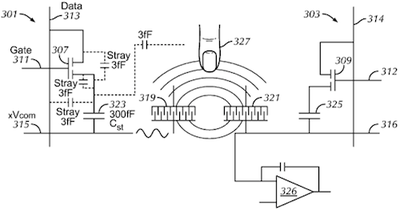
Patently Apple reports on a newly-published patent application from Apple disclosing research on touchscreen technology involving the use of pixels with dual-function capacitive elements that are capable of both displaying images and registering touch input. The invention is designed to simplify the current process of overlaying traditional image pixels with transparent touch sensing materials, thereby allowing for thinner and brighter touchscreen displays.

This relates to displays including pixels with dual-function capacitive elements. Specifically, these dual-function capacitive elements form part of the display system that generates an image on the display, and also form part of a touch sensing system that senses touch events on or near the display. The capacitive elements can be, for example, capacitors in pixels of an LCD display that are configured to operate individually, each as a pixel storage capacitor, or electrode, of a pixel in the display system, and are also configured to operate collectively as elements of the touch sensing system. In this way, for example, a display with integrated touch sensing capability may be manufactured using fewer parts and/or processing steps, and the display itself may be thinner and brighter.

The highly-technical patent application offers a number of examples of the technology, and provides three examples of devices that could benefit from the invention: an iPhone-like mobile phone, an iPod-like media player, and a personal computer. Not shown in the application but obviously a potential beneficiary of the technology would be a tablet-style device such as that rumored to be forthcoming from Apple.
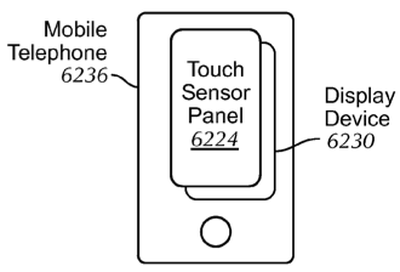
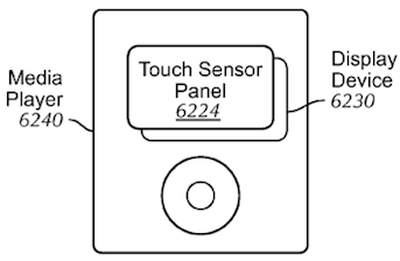
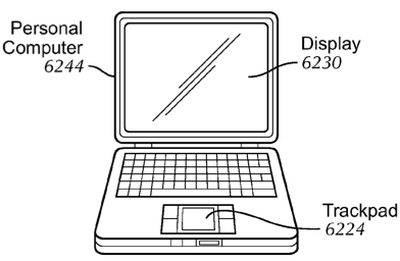
The patent application, which was filed on September 29th, 2008, is credited to several Apple inventors, including prominent engineers Steve Hotelling and John Zhong.

Top Rated Comments

(View all)

27 months ago
It's all falling into place. 20 days to go. :D
Rating: 0 Positives / 0 Negatives
27 months ago
Probably unlikely to be related to the tablet, but good to see they're looking at ways to bring the costs down and upping the efficiency.

It's all falling into place. 20 days to go. :D


Your zeen sig is scaring me...
Rating: 0 Positives / 0 Negatives
27 months ago
Very nice. Maybe throw in some pixel-level haptic feedback while your at it, Apple. :-)
Rating: 0 Positives / 0 Negatives
27 months ago

Probably unlikely to be related to the tablet


You never know. The patent was filed over 17 months before the rumored tablet ship date, and there's no telling how long they'd worked on it before they filed it.

It's certainly possible this could be something the new tablet uses.
Rating: 0 Positives / 0 Negatives
27 months ago
Yea, that would eliminate the need for the touch digitizer.

Would be interesting to see this in use.
Rating: 0 Positives / 0 Negatives
27 months ago
The buildup is crazy.
Rating: 0 Positives / 0 Negatives
27 months ago
There was a lot of fuss recently about a company that's invented a new type of screen that can flip from e-paper style to a full colour normal computer screen. I seem to remember MacRumors suggesting possible links with the Tablet. The only issue was that when in 'normal' mode, it's not as vibrant and bright as a normal LED screen.

If this patent allows the screen to be brighter, perhaps it could offset some of that problem?
Rating: 0 Positives / 0 Negatives
27 months ago
Notice the part in italics.

Apple's patent generally relates to displays having pixels that include capacitive elements, and more particularly to displays in which capacitive elements of the pixels that form part of the display system that generates an image on the display also form part of a touch sensing system that senses touch events on or near the display.
Rating: 0 Positives / 0 Negatives
27 months ago

Notice the part in italics.

Apple's patent generally relates to displays having pixels that include capacitive elements, and more particularly to displays in which capacitive elements of the pixels that form part of the display system that generates an image on the display also form part of a touch sensing system that senses touch events on or near the display.


Nothing to see here. All capacitive touchscreens sense touch events on or near the display. My first iphone I could "tap" when still about 2 mm off the screen. As a patent attorney, I also always hedge like that, lest some future infringer claim that the glass surface isn't "the display," etc.
Rating: 0 Positives / 0 Negatives
27 months ago

Nothing to see here. All capacitive touchscreens sense touch events on or near the display. My first iphone I could "tap" when still about 2 mm off the screen. As a patent attorney, I also always hedge like that, lest some future infringer claim that the glass surface isn't "the display," etc.


Patent Attorney or not, with all due respect, i think you may be missing the point of this patent and what it describes. Having your finger register a tap when 2mm away from the surface has NOTHING to do with this technology.

This describes an INTEGRATED on TFT Touch sensor and Display, as opposed to what every capacitive phone on the market today has, which is a touch overlay on TOP of the LCD.
Rating: 0 Positives / 0 Negatives

[ Read All Comments ]