The iPhone 15 Pro brings over 50 new features and improvements to Apple's high-end smartphones compared to the iPhone 12 Pro, which was released three years prior. This buyer's guide breaks down every major difference you should be aware of between the two generations and helps you to decide whether it's worth upgrading.
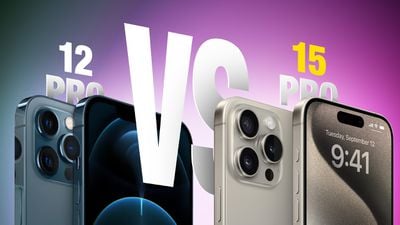
The iPhone 12 Pro debuted in 2020, introducing the A14 Bionic chip, MagSafe, improved water resistance, Ceramic Shield glass, 2GB more memory, a LiDAR scanner, Night mode portraits and Apple ProRAW images, HDR video recording with Dolby Vision, and a larger display on the smaller model. The iPhone 12 Pro was discontinued upon the announcement of the iPhone 13 Pro in 2021, but it is still possible to get hold of it at fairly low prices second-hand.
Our guide helps to answer the question of how to decide which of these two iPhone models is best for you by clearly showing all of the differences that the iPhone 15 Pro brings to the table. This article focuses on the iPhone 12 Pro and iPhone 15 Pro, but to understand the differences between the iPhone 14 Pro and iPhone 15 Pro, see our other buyer's guide:
Although the iPhone 12 Pro and iPhone 15 Pro share most of their basic features, the iPhone 15 Pro offers a large number of notable upgrades, such as a titanium design, always-on Retina display with ProMotion, Action button, USB-C port, 48-megapixel main camera, A17 Pro chip, and longer battery life.
| iPhone 12 Pro | iPhone 15 Pro |
|---|---|
| Surgical-grade stainless steel chassis with squared-off edges | Aerospace-grade titanium chassis with contoured edges |
| More repairable design | |
| 7.4mm depth | 8.25mm depth (0.6mm thicker) |
| 187g or 226g weight | 187g or 221g weight |
| "Notch" TrueDepth camera array | TrueDepth camera array with Dynamic Island |
| Thinner borders around the display for slightly smaller overall footprint | |
| 1,200 nits peak brightness (HDR) | 1,600 nits peak brightness (HDR) and 2,000 nits peak brightness (outdoor) |
| ProMotion technology for refresh rates up to 120Hz | |
| Always-On display | |
| Ring/Silent switch | Action button |
| A14 Bionic chip (5nm) | A17 Pro chip (3nm) |
| 4-core GPU | 6-core GPU with with hardware-accelerated ray tracing |
| Dedicated AV1 decoder | |
| 6GB memory | 8GB memory |
| 12-megapixel main camera with ƒ/1.6 aperture | 48-megapixel main camera with ƒ/1.78 aperture and larger sensor |
| 12-megapixel ultra-wide camera with ƒ/2.4 aperture | 12-megapixel ultra-wide camera with ƒ/2.2 aperture |
| 12-megapixel telephoto camera with ƒ/2.0 aperture and sensor-shift optical image stabilization | 12-megapixel telephoto camera with ƒ/2.8 aperture and larger sensor, folded tetraprism design, optical image stabilization, and autofocus 3D sensor-shift module (Pro Max only) |
| 12-megapixel front-facing camera with ƒ/2.2 aperture | 12-megapixel front-facing camera with ƒ/1.9 aperture and autofocus |
| Anti-reflective coating on camera lenses | |
| True Tone flash | Adaptive True Tone flash |
| 0.5x, 1x, and 2x optical zoom | 0.5x, 1x, 2x, and 3x optical zoom (5x instead of 3x on Pro Max) |
| 13mm, 24mm, 28mm, 35mm, and 77mm focal length picker (120mm instead of 77mm on Pro Max) | |
| 24- and 48-megapixel super-high-resolution photos | |
| Photonic Engine | |
| Smart HDR 3 | Smart HDR 5 |
| Photographic Styles | |
| Macro photography | |
| Portrait mode with Depth Control | Next-generation portraits with Focus and Depth Control |
| Night mode and Night mode portraits | Improved Night mode and Night mode portraits |
| Shoot and instantly transfer 48-megapixel ProRAW images to Mac via USB 3 | |
| Record video directly to an external drive | |
| ProRes video recording up to 4K at 60 fps with external recording | |
| Cinematic mode for recording videos with shallow depth of field (4K HDR up to 30 fps) | |
| Action mode | |
| Log video recording | |
| Academy Color Encoding System | |
| Record spatial video for Apple Vision Pro | |
| Improved audio quality on phone calls | |
| Bluetooth 5.0 | Bluetooth 5.3 |
| Wi‑Fi 6 connectivity | Wi‑Fi 6E connectivity |
| Thread networking technology | |
| First-generation Ultra Wideband chip | Second-generation Ultra Wideband chip (connects from 3x further away) |
| Precision Finding for Find My friends | |
| Emergency SOS | Emergency SOS and Roadside Assistance via satellite |
| Crash Detection | |
| eSIM optional | eSIM only (in the U.S.) |
| Lightning port | USB-C port |
| USB 2 transfer speeds (up to 480Mb/s) | USB 3 transfer speeds (up to 10Gb/s, 20x faster) |
| DisplayPort support for up to 4K HDR video output | |
| Support for Qi wireless charging | Support for Qi 2 wireless charging |
| 17- or 20-hour battery life | 23- or 29-hour battery life |
| Setting to prevent charging above 80% | |
| Battery manufacture date, first use, and cycle count information in Settings | |
| 128GB, 256GB, and 512GB storage options | 128GB, 256GB, 512GB, and 1TB storage options (no 128GB tier on Pro Max) |
| Pacific Blue, Silver, Gold, and Graphite color options | Natural Titanium, Blue Titanium, White Titanium, and Black Titanium color options |
Overall, the iPhone 15 Pro is a significant upgrade over the iPhone 12 Pro, with significant changes in virtually every area of the device. The display's Dynamic Island, always-on functionality, ProMotion technology for refresh rates up to 120Hz, slimmer bezels, and considerably higher peak brightness make for significant changes on the front of the device, while the switch to a titanium chassis, USB-C port, and Action button are similarly noticeable elsewhere. The photography and videography capabilities of the devices radically differ, with over 20 of the differences between the smartphones relating to camera technologies. The iPhone 15 Pro's more repairable design, 2GB of additional memory, and A17 Pro chip also ensure that it will be a more future-proof device.
Due to the scale and breadth of these improvements, most iPhone 12 Pro users will be able to justify upgrading to the iPhone 15 Pro, especially if they value its more refined design, USB-C port, Action button, and camera improvements. It is only worth sticking with the iPhone 12 Pro if you are holding off for an even more substantial upgrade with next year's iPhone 16 Pro, but many users will see a multitude of tangible benefits by upgrading now.