A recent Apple patent application entitled "Media Data Exchange, Transfer, or Delivery for Portable Electronic Devices" is generating some buzz.
The patent application was filed on September 1, 2006 and addresses methods for mobile devices to wirelessly discover others in the local vicinity and transmit data from one another. Examples of data shared include video, music, games, photos, playlists, and slideshows. They do make special note of restricted sharing for certain media that may have "limited-use rights".
Electronista notes that the method could be used for something more useful than just one-to-one transfers:
Users could even create a random or semi-random effect through this method by telling the device or server on the opposite end to randomly load the device with content, similar to the way the iPod shuffle's AutoFill creates a new mix of songs through USB.
Some comparisons are being made to Microsoft's Zune product which allows Zune-to-Zune wireless sharing, though Zune's launch was approximately 2 months following the filing of this patent application. As well, historically, Apple has explored similar auto-discovery techniques (over RF at the time) with early prototypes of the Apple Newton (pre-1993).
As noted by Macworld, the latest version of Quicktime 7.2 released just yesterday brings new video Export options for the iPhone.
QuickTime 7.2 adds two new export features into the application Export for iPhone and Export for iPhone (Cellular). The former exports a .m4v video, while the latter exports in the smaller .3gp format.
The preset options allow you to export your videos in an iPhone optimized format.
A new posting at Cups.org reveals that Apple has purchased CUPS and hired its author:
In February of 2007, Apple Inc. acquired ownership the CUPS source code and hired me (Michael R Sweet), the creator of CUPS. CUPS will still be released under the existing GPL2/LGPL2 licensing terms, and I will continue to develop and support CUPS at Apple.
CUPS stands for Common Unix Printing System and was adopted by Apple in 2002 for Mac OS X. CUPS is also heavily used by Linux distributions for printing services.
Techworld reports on two options for Microsoft Exchange synchronization and support for the iPhone.
The two include, Visto and Synchronica. Due to Apple's reluctance to open the iPhone to 3rd party applications, both services provide different approaches:
Visto, for instance, which usually writes small handset-based applications to allow its email sync functions to work, will use a desktop PC-based application to forward corporate email to the iPhone
[Synchronica's] Mobile Gateway doesn't require system administrators to open ports in the firewall or install Exchange connectors. Instead it uses a separate server, located behind the firewall, that sucks in email via Outlook Web Access, already activated on many corporate email accounts.
The iPhone is an awesome device and will no doubt be a trendsetter for future devices similar to the way the iPod defined the way portable music should be. However, some iPhone owners have been discovering the cost of being on the bleeding edge of technology.
Currently, there are various bugs plaguing the iPhone's software. These bugs range from minor, application-specific bugs to somewhat major application crashes. We are currently hosting a thread for bug reports, in addition to an entire forum for tips, help, and troubleshooting. If you feel you have identified a bug that has not already been identified as confirmed, let us know (we'll pass it on to Apple once its confirmed as a bug).
In a non-bug related issue that potential purchasers should be aware of, with the iPhone being a GSM device, it can create interference with audio systems, speaker phones, and some CRT televisions. I have experienced this issue with my iPhone and my car audio system and with my computer's Harmon-Kardon SoundSticks. For more on this issue, continue reading (same issue, different phone).
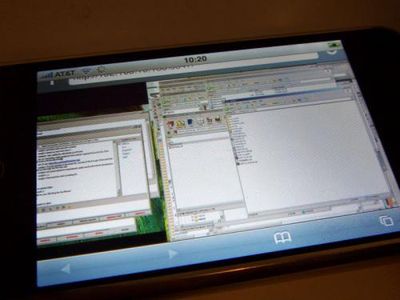
One iPhone user successfully modified a version of TightVNC to allow him to control his Windows PC from his iPhone.
WebVNC is a modification of the VNC server. Where before the HTTP server in VNC would just serve a Java applet, now it serves an AJAX application that downloads the screen as a set of JPEG images. The application then checks back with the server to see which ones have changed, and reloads them. Input is just another message to the server.
The web-based interface supports Mouse Clicks, Scrolling, Drag/Drop and text entry. Due to the use of Windows-specific functions, the application is only supported on Windows at this time. A downloadable binary is offered along with source code.
One of the reader comments suggests that LogMeIn.com could be another alternative if you set your preferences to "HTML", but in brief testing, I was unable to emulate mouse functions over the web interface.
Several stories today came out about a hearing at the House Subcommittee on Telecomunications and the Internet.
During the hearing of the House Subcommittee on Telecommunications and the Internet, representatives from both sides of the aisle called for a more open wireless system where new innovations aren't held hostage to the competition-killing carriers that control the network.
The iPhone was used as an example of a mobile phone tied to its carrier. AT&T has a (rumored) 5 year exclusive contract with the iPhone -- restricting use with other providers.
Several industry critics who testified at the hearing noted that Asia and Europe obligate carriers to ensure that any device will work with their networks. Wireless entrepreneur Jason Devitt, chief executive of SkyDeck, said 800 devices would work on Vodafone Group plc's wireless network in Europe, whereas only 30 devices work on Verizon's network in the U.S.
Apple has released a minor update to its iTunes software. According to Apple, "iTunes 7.3.1 addresses a minor problem with iTunes 7.3 accessing the iTunes Library." The update can be downloaded from Apple's website for Mac or PC, or via Software Update.
Apple also released Quicktime 7.2, which addresses critical security issues and delivers: - Support for full screen viewing in QuickTime Player - Updates to the H.264 codec - Numerous bug fixes
The update can be downloaded from Apple's website for Mac or PC, or via Software Update. More information regarding the security fixes can be found here.
DigiTimes claims that Wintek has been given the contract award for producing the the panels of Apples upcoming iPod refresh, which DigiTimes notes will be in August. The touch screens will reportedly be similar to the iPhone's touch screen.
Steve Jobs made comments during a town hall meeting of Apple Employees that the Mac OS X group was working on unreleased iPods as well as the desktop OS and iPhone OS.
Ecamm Network has released a Mac OS X application called iPhoneDrive which allows you to store arbitrary files onto your iPhone. The purpose appears to be a way to emulate "drive mode" with the iPhone, allowing you to use your iPhone as an expensive USB flash drive.
The software provides no access to other files on the iPhone, so you can't copy photos, music, movies that have previously been synced with iTunes.
The system requirements include Mac OS X 10.4.10 and iTunes v7.3 and costs $9.95 for the full version. A free week long demo is provided.
MyiTablet points to a YouTube video which shows one user using a custom ringtone on the iPhone.
It appears to be a proof of concept only. Progress on iPhone hacking has progressed, but few end-user tools are presently available to accomplish anything useful at this point.
The iPhone and I took a little trip to the Blue Bell Creameries in Brenham, TX yesterday. We went on a tour and it was all very fun and very tasty (you get ice cream at the end!) but I was concerned about how the iPhone would operate in a small town.
While Brenham isn't exactly a small town, as it has a population of about 13,500, I've lived in Houston (population about 2.1 million) my whole life. I'm used to having a Starbucks on every corner, four shopping malls within 20 minutes, and seeing cell phone towers dot the landscape.On the way up, my mother doubted my navigational abilities. We had been on 290 for about an hour and fifteen minutes when she demanded I check the map. I pulled over in the middle of nowhere, fired up Google Maps and found Brenham. Though I would've enjoyed having built-in GPS in the iPhone, all I needed to do was verify that 290 does, in fact, go to Brenham.
But since I had no idea of where I was, other than "on 290," we did have to turn on our Mio GPS and put in the creamery to get an ETA. If I didn't have that GPS, I'd probably still be hearing about how I got us unspeakably lost, but thankfully I did. As it turns out, GPS successfully lead us to our destination with his cute little British accent.
Around the city, I almost always had five bars of reception while my mother (on Virgin Mobile) had absolutely no service for 90% of the time, and only two bars when she did. While calling my brother from Brenham to our house in Houston, the quality was clear and excellentjust as good as if I were calling from inside the house.
EDGE speeds were pleasantly surprising, too. Inside the creamery after our post-tour scoop, I googled for a restaurant at which to have lunch. Even inside the giant ice cream factory, I had five bars of reception. I quickly pulled up all sandwich shops in downtown Brenham while my mom was still getting verbal directions from the two tour guides cleaning up the ice cream counter. One asked if my phone was the new "iTunes Apple phone" and I offered to let him play with it in hopes of getting another cup of Buttered Pecan. Unfortunately, he was covered in ice cream and didn't want to get any on the phone.
While sitting at lunch, I emailed a picture of my sandwich to a friend. I heard the little wooshy "sent" noise about 10 seconds later, just the same amount of time it takes while in Houston via EDGE. In the end, I was terribly impressed with AT&T's coverage in a small town. It was better there than in parts of Houston.
Canada.com cites an industry expert who notes that wireless data rates are significantly higher in Canada than in the U.S. A data plan comparable to AT&T's iPhone data plans would reportedly run $295/month at the current rates.
The article speculates that this would either delay the iPhone's offering or require major data pricing changes prior to its introduction. The iPhone data/internet connectivity is one of its major features.
Jott.com provides an interesting service for iPhone (or any mobile) phone users. The free service allows you to dictate short messages to yourself or to others over your mobile phone.
The intent is to provide a way for people "on the go" to send themselves and others short text messages just by using your voice. A toll free number is provided which identifies you based on your mobile phone caller id. You are prompted for who you'd like to "Jott" to and you then record your message. The message is then transcribed (by humans) and sent to the recipient.
When you receive the message, a link to the audio is also provided (sample) in case the transcription is somehow missed.
Mashable reports that Jott is venture capital funded and plans to keep the basic service free.
Jiwire.com now offers an iPhone optimized version that allows you to search for Free Wifi hotspots around the world. Jiwire claims to have a database of over 150,000 Wifi locations in 135 countries.
You can visit iphone.jiwire.com from your iPhone or from your desktop browser to test out their service.
An increasingly popular thread on Apple's discussion boards appears to pin WiFi problems some MacBook users have been experiencing on the Mac OS 10.4.10 update. Users with the issue appear to experience symptoms ranging from WiFi dropouts to kernel panics.
Gaging the severity of a problem is always difficult to do from forum threads, as typically only people who have issues voice concerns. However, Mac OS 10.4.10 has had its share of bugs, already being patched once due to an audio issue with Intel-based Macs.
Update: Reports indicate that Apple's engineering team has acknowledged the issue as a bug and is working towards a resolution.
MacScoop claims that according to "trusted sources" Apple is planning on releasing "a notebook that is so small and light that it could redefine the standards of ultra-portable computing."
The upcoming Apple notebook is said to feature a 12" display, 0.6-0.7 inches thick, and weigh less than 3 pounds. MacScoop's sources are unclear if an optical drive will accompany this ultra-portable notebook, but do feel it is likely to come by year's end (2007).
For reference, Apple's current 15" MacBook Pro weighs 5.4lbs with a 1 inch thickness.
Rumors of a ultra-portable Apple laptop have been ongoing since late 2006. MacScoop reported in December 2006 about the upcoming 12" ultra-portable MacBook Pro with additional details provided by Appleinsider in February. There are some conflicting reports with one summary that believed the ultra-portable would carry a 13" LED display.
Apple's first foldable iPhone, with a book-style design featuring a ~5.5-inch outer display and a ~7.8-inch inner display with a minimal crease down the middle.