Apple Briefly Posts China Guide for Connecting Siri to Qwen AI - MacRumors
Skip to Content

Apple Briefly Posts China Guide for Connecting Siri to Qwen AI

Apple briefly published a support guide in China explaining how Mac users can connect Alibaba's Qwen AI to Siri and Writing Tools, before pulling it entirely less than a day later.

apple intelligence black
Reuters first spotted the Chinese-language guide on Apple's support site on August 8, which explained how eligible Mac users in mainland China could connect Qwen, Alibaba's family of generative AI models, to ‌Siri‌ and Writing Tools. According to the document, the extension required macOS 26.6 or later, needed users to sign into their own Qwen account, and specified that Alibaba was barred from using submitted materials to train or improve its models.

‌Siri‌ would be able to lean on Qwen for more detailed responses to certain requests, including analysis of photos and documents, while Writing Tools could use it to generate text and images. No equivalent guide was published for the iPhone or iPad.

The setup closely mirrors Apple's existing ChatGPT extension available elsewhere, which similarly lets ‌Siri‌ hand off complex requests and gives Writing Tools a "Compose" option, all on an opt-in basis.

By August 9, the guide had been removed. Chinese news aggregator ReadHub reported that the guide had disappeared from Apple's site, and TechNode reports that Apple's customer service told Chinese media it had received no notification of a new feature launch. Separately, tech analyst Liu Dingding told the Global Times that the takedown could reflect pending technical adjustments still tied to the regulatory process, rather than a full reversal.

It's a similar pattern to what happened back in March, when Apple Intelligence itself briefly went live for some Chinese users before being pulled offline without regulatory approval. China maintains strict rules around releasing AI features, and in practice requires companies like Apple to partner with local providers. Apple originally lined up Baidu as its primary China AI partner, but by February 2025, reports indicated Alibaba had taken over as the lead partner after Baidu's models fell short of Apple's requirements, with Baidu shifted to a supporting role.

Chinese regulators cleared Apple Intelligence for launch in the country in July, registering Apple's on-device AI service with the Cyberspace Administration of China. That approval covered the iPhone only, and Apple did not say whether or when the ‌iPad‌ and Mac would follow, making this week's brief Mac-specific guide the clearest signal yet on the Mac timeline specifically.

It remains unclear when Apple will formally relaunch the Qwen integration for the Mac, or whether the guide's brief appearance points to an imminent rollout.


Popular Stories

macOS iOS 27 Siri App Feature

Apple's Siri AI Can Be Swapped Out for Claude, ChatGPT, Code Shows

Monday September 14, 2026 4:37 am PDT by
Code sleuth "pdfu" has uncovered iOS 27 and macOS Golden Gate private frameworks that show Apple has designed its new Siri architecture to work with third-party AI models at what appears to be a surprisingly deep level. One mechanism called Model Delegation allows Claude to appear as a Siri extension in the same way as the existing built-in ChatGPT extension. In pdfu's video, shared on X,...
iOS 27 Out Now Thumb

Apple Releases iOS 27 and iPadOS 27 With Siri AI and Liquid Glass Update

Monday September 14, 2026 10:04 am PDT by
Apple today released iOS 27 and iPadOS 27, the newest operating system updates for the iPhone and iPad. The software is available for free on all compatible devices, and can be downloaded over the air by going to Settings > General > Software Update. Subscribe to the MacRumors YouTube channel for more videos. It can take several minutes for the updates to propagate to all users due to high...
apple watch series 12 siri recap

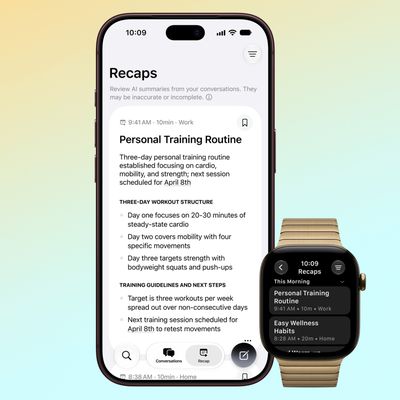
Apple Explains What Happens to Conversations Siri Recap Hears

Thursday September 10, 2026 4:38 pm PDT by
The Apple Watch Series 12 and Ultra 4 have new Audio Intelligence features that include Sound Recognition, Music Recognition, Live Rewind, and Siri Recap. When these features are activated, the new Apple Watches are always listening to what's going on around the wearer. With Siri Recap, the Apple Watch listens to your conversations throughout the day and takes notes. It uses Apple...

Top Rated Comments

5 weeks ago

I wonder which PR speak covers this situation:
1. From time to time, Apple removes documents. Apple generally doesn’t discuss their internal deliberations.
2. At the very last minute, Apple discovered X, so Apple had to pull the guide.
3. Siri met Kimi and liked her better.
Score: 5 Votes (Like | Disagree)
5 weeks ago
I use Qwen 35B on my MacBook Air M5. It’s very nice and helpful to me. Even though the time to first token is quite long. But then you get about 50t/s, which is more than enough for me. I really like it!
Score: 3 Votes (Like | Disagree)
JosephAW Avatar
5 weeks ago
How about allowing US users to connect to our own local LLM running on Apple Silicon? :rolleyes:
Score: 3 Votes (Like | Disagree)
5 weeks ago
I wouldn't be surprised if Qwen AI is directly tied to the CCP.
Score: 2 Votes (Like | Disagree)
5 weeks ago

It's based in China. It makes no difference if it's fully owned and operated by the CCP or fully owned and operated by a private citizen; the effect is the same. The CCP has the authority to obtain any information they want from their domestic corporations.

This is not speculation; it's been widely reported ('https://www.cisecurity.org/insights/blog/the-chinese-communist-party-ccp-a-quest-for-data-control'). It's also the primary reason that the US government takes issue with US companies outsourcing to China.
But open weight models like Qwen can be downloaded and run offline, how does an offline model send data to China.
Score: 1 Votes (Like | Disagree)
zarmanto Avatar
5 weeks ago

I wouldn't be surprised if Qwen AI is directly tied to the CCP.
It's based in China. It makes no difference if it's fully owned and operated by the CCP or fully owned and operated by a private citizen; the effect is the same. The CCP has the authority to obtain any information they want from their domestic corporations.

This is not speculation; it's been widely reported ('https://www.cisecurity.org/insights/blog/the-chinese-communist-party-ccp-a-quest-for-data-control'). It's also the primary reason that the US government takes issue with US companies outsourcing to China.
Score: 1 Votes (Like | Disagree)