Steve Jobs Deposition Video Shown in Ongoing iPod Class-Action Lawsuit

jobs_poseApple is in court this week dealing with an ongoing class-action lawsuit that accuses the company of purposefully crippling competing music services and inflating prices by locking iPods and iTunes music to its own ecosystem.

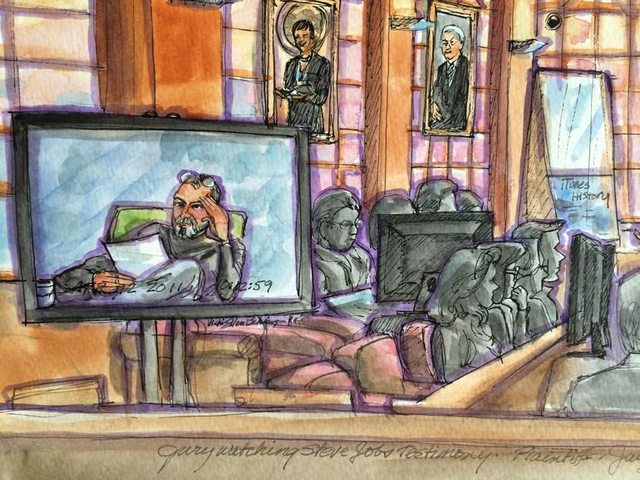
Evidence from Steve Jobs, in the form of a series of emails, has played a large role in the case so far, and today, the former Apple CEO was featured in the trial again, when a deposition videotaped in 2011 was shown in court. CNET has been attending the trial since it started earlier this week, and has relayed what Jobs had to say.

In the deposition, taped six months before his death, Steve Jobs echoed much of what Eddy Cue said earlier in the week, suggesting Apple's contracts with record companies forced it to maintain airtight Digital Rights Management (DRM) policies that locked out music from other sources.

"We had pretty much black and white contracts with the labels," Jobs said in the deposition. Those contracts stipulated that if people violated Apple's FairPlay digital rights management system, a technology that would detect other music stores' song files and prevent users from loading them onto the iPod, "... that would be in clear violation of the licenses we had from the labels and they could cease giving us music at any time."

Jobs went on to say that Apple was "very concerned" with RealNetwork's efforts to bypass Apple's DRM. In 2004, the competing music store reverse engineered the FairPlay DRM, gaining access to the iPod. Apple was unhappy with the move, painting RealNetworks as a hacker and later updating iTunes to once again prevent RealNetworks music from playing on the iPod.

According to Jobs, preventing the iPod from playing music from competing services was "collateral damage" caused by record companies confusing demands asking Apple to both open its platform to competitors and prevent hacking via DRM.

During the case, the plaintiffs have argued that Apple had an obligation to allow third-party companies to load music onto the iPod, and that its move to block competitors created a monopoly. Apple, meanwhile, has argued that pressure from record companies and a desire to protect customers from malicious content kept it from making iTunes and the iPod more accessible to third-party companies.

Apple has also suggested that it did not have a monopoly in the market at the time as there were several other MP3 players available, including Microsoft's Zune. As noted by CNET, Jobs' deposition may somewhat undermine that argument, however, as he told the court "We were the only big company involved in this stuff at this time, the one with the deepest pockets."

The iPod antitrust lawsuit, which seeks $350 million in damages, is expected to last for several more days, though Apple is currently attempting to get the case dismissed entirely, as one plaintiff has been removed from the lawsuit and another's iPod purchase dates are in question. The plaintiff's lawyers are fighting Apple's dismissal request and have asked the judge to add a new plaintiff -- a Michigan man who bought an iPod touch in 2008.
Popular Stories

maxresdefault

Apple Shows Off a Key Reason to Upgrade to the iPhone 17

Saturday February 7, 2026 9:26 am PST by
Apple today shared an ad that shows how the upgraded Center Stage front camera on the latest iPhones improves the process of taking a group selfie. "Watch how the new front facing camera on iPhone 17 Pro takes group selfies that automatically expand and rotate as more people come into frame," says Apple. While the ad is focused on the iPhone 17 Pro and iPhone 17 Pro Max, the regular iPhone...
apple wallet drivers license feature iPhone 15 pro

Apple Says These 7 U.S. States Plan to Offer iPhone Driver's Licenses

Monday February 9, 2026 6:24 am PST by
In select U.S. states, residents can add their driver's license or state ID to the Apple Wallet app on the iPhone and Apple Watch, and then use it to display proof of identity or age at select airports and businesses, and in select apps. The feature is currently available in 13 U.S. states and Puerto Rico, and it is expected to launch in at least seven more in the future. To set up the...
m5 macbook pro deal

Why You Shouldn't Buy the Next MacBook Pro

Tuesday February 10, 2026 4:27 pm PST by
Apple is planning to launch new MacBook Pro models as soon as early March, but if you can, this is one generation you should skip because there's something much better in the works. We're waiting on 14-inch and 16-inch MacBook Pro models with M5 Pro and M5 Max chips, with few changes other than the processor upgrade. There won't be any tweaks to the design or the display, but later this...
iOS 26

Apple Releases iOS 26.3 and iPadOS 26.3

Wednesday February 11, 2026 10:07 am PST by
Apple today released iOS 26.3 and iPadOS 26.3, the latest updates to the iOS 26 and iPadOS 26 operating systems that came out in September. The new software comes almost two months after Apple released iOS 26.2 and iPadOS 26.2. The new software can be downloaded on eligible iPhones and iPads over-the-air by going to Settings > General > Software Update. According to Apple's release notes, ...
Apple Logo Zoomed

Apple Expected to Launch These 10+ Products Over the Coming Months

Tuesday February 10, 2026 6:33 am PST by
It has been a slow start to 2026 for Apple product launches, with only a new AirTag and a special Apple Watch band released so far. We are still waiting for MacBook Pro models with M5 Pro and M5 Max chips, the iPhone 17e, a lower-cost MacBook with an iPhone chip, long-rumored updates to the Apple TV and HomePod mini, and much more. Apple is expected to release/update the following products...

Top Rated Comments

146 months ago
its always kind of confounded me why this was a big issue? it was pretty clear at the time that it was the label's insistence that resulted in having DRM, there would have been no way of getting them onboard otherwise... I think its pretty obvious Jobs was against cumbersome and limiting copy-protection mechanisms and his testimony would somewhat back that up. And it wasnt like it was a huge deal to get around if you were in the least bit tech-saavy. lastly, i seem to recall that at the time period, everybody's players were pretty much locked down to their own content stores.

----------

This might all fall apart, the plaintiffs might not have, you know, actually bought iPods in the right time period to be valid plaintiffs...

http://www.bbc.com/news/technology-30343686

eeeeexactly. this whole thing kinda stinks to me as a shameless moneygrab really.
Score: 12 Votes (Like | Disagree)
sshambles Avatar
146 months ago
What a waste of time and money this thing is. Seriously.
Score: 11 Votes (Like | Disagree)
bpeeps Avatar
146 months ago
After the 9th article about this, I would love to see the Jobs video.
Score: 8 Votes (Like | Disagree)
mdridwan47 Avatar
146 months ago
I would love to see the video!

Score: 7 Votes (Like | Disagree)
smithrh Avatar
146 months ago
This might all fall apart, the plaintiffs might not have, you know, actually bought iPods in the right time period to be valid plaintiffs...

http://www.bbc.com/news/technology-30343686
Score: 7 Votes (Like | Disagree)
146 months ago
Apple should ask if a Zune would play music from the iTunes Store

...Of course, to find that out, they would have to find someone who owned a Zune!

(ZZIIINNNGG!!) :D
Score: 6 Votes (Like | Disagree)