Toshiba Introduces New 6.1-Inch Display at 498 PPI
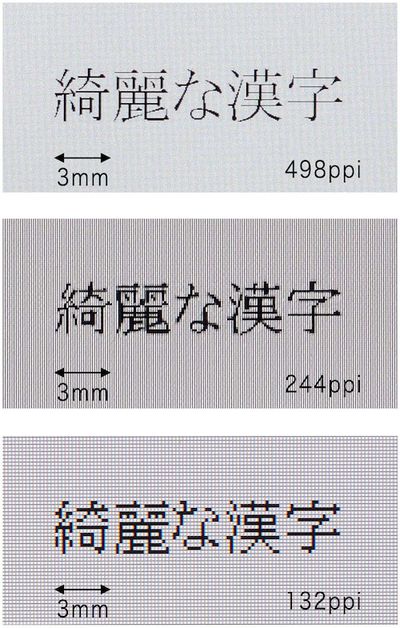
Magnified comparison of Toshiba's new 498 ppi display with lower-resolution displays
Toshiba is now pushing the idea even further, today introducing a new 6.1-inch display offering a resolution of 2560 x 1600, coming in at 498 ppi.
This newly-developed world-class, high-definition LCD panel is based on our processing techniques for forming fine-pitch and high-performance, low-temperature poly-silicon (LTPS) thin-film transistors (TFT) on glass substrates, and other precise fabrication techniques which have been cultivated over the years. This direct-view LCD panel achieves high-definition images with photographic quality, and although the images are displayed in 2D format, they impart a sense of depth and realism.
Apple obviously does not currently offer a mobile product in the range of 6.1 inches and other considerations such as ensuring a smooth transition from lower-resolution displays would likely preclude the company from utilizing this exact display, but it is clear that the technology is advancing rapidly to enable ever higher display quality. As mobile devices continue to see increased graphics capabilities and costs fall into line with existing technologies, such ultra high resolution displays are likely to see significant adoption.Top Rated Comments
(View all)Don't get me wrong - I think this is great. I just am having trouble figuring out any practical applications for this sort of pixel depth. Would there be any tangible benefit to the increased cost?
I do dream of the day when 30in. monitors that are capable of 300ppi are affordable...
Even print design work is only 300.
There was a lot of debate about this when iPhone 4 first introduced Retina, but when laser printers made the jump from 300DPI to 600DPI, the printed text looked notably better, even if one's eye can't really detect individual dots at 600DPI....
So, a larger screen iPhone with Retina display is possible then, correct?
Keep in mind the term "Retina Display" is Apple marketing speak. I am guessing they will be fairly fluid with the definition, and continue using it for the high-res iPad, which after pixel doubling will not reach 324ppi.
From what I understood 500ppi is about as much as the human eye can discern, so it makes sense to get the technology to this point. Even if we rarely have our devices less that 12" from our faces.
Oh God, first a 4" android phone.. then 4.5".. now the Nexus with its 4.65" screen.. now this 6.1"? When will it stop?!
I doubt that it's intended for a phone. 6" happens to be the average size for e-readers though.I think the 300dpi theory is for AVERAGE human eyes, so 50% people are able to see more detailed stuffs :p
Do you know what means average?
[ Read All Comments ]

Accessory maker Moshi has released a new ultra-thin plastic shell protective case for the 11" and 13" MacBook Air models. This type of plastic case tends to be especially popular among...
Blizzard Entertainment said this week that it sold more than 3.5 million copies of Diablo III on launch day, setting the record for fastest-selling PC game. The company also sold 1.2 million copies...
Hard drive maker Seagate has announced it will purchase data storage device maker LaCie for roughly $186 million.
The company plans to buy the controlling stake owned by Philippe Spruch,...
Intuit has upgraded the iOS app for its Mint personal finance tool with two new "most-requested" features that should keep users from ever having to go to the Mint.com website. Until now,...