U.S. Carriers Cracking Down on Android Hotspot Tethering Apps
Image from Engadget
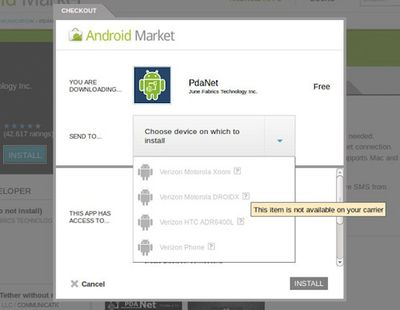
Droid Life reports (via Engadget) that U.S. carriers have recently stepped up their efforts to crack down on Android apps that permit users to create Wi-Fi mobile hotspots by tethering to their mobile phone and using the device's data connection.
After receiving a tip that Verizon may be blocking Wireless Tether from the market, I decided to do a little digging on the variety of devices I own. Sure enough, from all of my phones, including the Nexus S I have running on AT&T, I was unable to find Wireless Tether in the market. So to see what was really going on, I jumped into the browser-based Android Market to see if I could find the app and definitely did. But what you are seeing, is my list of devices, all of which cannot accept this app.
One of the main promotional points of Android as its popularity has soared has been the unregulated nature of the app marketplaces for the platform. As opposed to Apple's belief that customers are better served by a marketplace in which Apple serves as the gatekeeper to ensure that apps meet certain standards, Android has been much more of a free-for-all with developers free to release nearly any type of application for use on compatible devices.As Android has gained in popularity, however, things have begun to tighten up, with Google recently exerting control in an attempt to reduce fragmentation in what has long been billed as an open system available for tweaking and customization by any and all who wish to deploy hardware utilizing the platform.
But it certainly appears that even carriers are now getting into the act, seeking to cut off at the source consumer access to apps that can violate the carriers' terms and conditions rather than dealing with customers directly. Users can of course work around carrier restrictions with methods known as "sideloading" that allow users to install apps through unapproved sources, but most casual users are undoubtedly sticking to mainstream, authorized marketplaces such as the Android Market for their needs.
The iPhone has supported tethering via USB and Bluetooth directly via the operating system for some time now, and has recently added Wi-Fi hotspot functionality. These features do, however, require support from individual carriers, many of whom charge extra for the privilege of using them. Some users have worked around those restrictions by jailbreaking their devices and installing apps such as MyWi, although carriers such as AT&T have recently increased their efforts to identify those users and move them to more expensive data plans officially supporting the hotspot functionality.
Top Rated Comments
(View all)And why is this on mac rumors.
Does it really matter what the competition does.
Why read it if you are not interested?
And why is this on mac rumors.
Does it really matter what the competition does.
Maybe to let us know they're not just cracking down on iPhone owners?
I don't really get this... You already pay fees for the data - why do they care for how you use it?
Two answers come to mind:[list=1][*]Tetherers tend to use more bandwidth, to serve more devices. You pay for a certain amount of bandwidth but the carriers much prefer that you use less than the purchased allotment.
[*]As long as the ability to tether is worth something to consumers the carriers can charge for it because many people will be willing to pay for the feature.[/list]
And why is this on mac rumors.
Does it really matter what the competition does.
It's not what the competition does, it's what the wireless companies are doing to the competition (and which they've already done to iPhones).
Maybe to let us know they're not just cracking down on iPhone owners?
And also maybe to suggest that "open" isn't all it's cracked up to be. The promise of an open system doesn't always play out in the real world. It works well for geeks who know what they're doing, but for the average consumer it can create a big headache (inadvertently installing a rogue program, for instance). It's a trade-off: more freedom vx. more stability.
Anyone with an Android phone can root and install vanilla Android, or a custom rom like Cyanogenmod, relatively easily.
Why is it that Google always touts how open is so good, then they realize that, oh, guess we should tighten things up a bit, maybe being too open is not such a good thing.
Problem is that it is mostly open for the carriers to do whatever they want - less open for the user thanks to carrier modifications to the OS.
Shocking that carriers would take steps to stop people from stealing service from them.
Too many people think they are entitled to get everything for free. No matter if it is a new service for $20 a year or if it is tethering they didn't pay for ... Don't know where people get it from that they should get everything for free (or cheap). If you want tethering, pay for it. The cell phone planes (without tethering) are calculated on a typical single (mobile) device usage - using it for more devices is stealing (you know, you signed the contract with the rules - if you don't like it you shouldn't have signed up)
[ Read All Comments ]

As noted by ifoAppleStore, Apple is continuing its trickle of retail store openings this week with a new location opening on Friday, May 25 in Paris. The new Les Quatre Temps store will be...
TiVo owners can control their devices via an iOS app on the iPhone and iPad, but -- for the moment -- can only watch shows on their television.
But that's all going to change in a few months....
Binary Nights has dropped the price of its file-transfer app ForkLift to $0.99, down from $29.99, for a limited time.
ForkLift is a well-reviewed file management app that offers FTP, SFTP,...