Got a tip for us? Share it...

Mac Marketshare Growth in High End Retail Market

eWeek first reported on an interesting breakdown of Apple's retail marketshare. According to numbers from the NPD Group, Apple's Q1 2008 retail (brick and mortar) reached 14%. Note that by limiting it to retail, they've excluded online sales and institutional/enterprise sales.
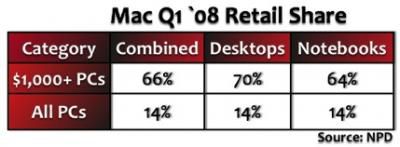

Chart from eWeek

More surprising, however, is if you limit the data to computers priced above $1,000, Apple represents 66% of all retail computer sales.

Apple's success above $1,000 defies some of the conventional retail thinking about PCs, where the emphasis is on lower pricing and greater features. "Consumers don't care about features," Stephen asserted. "People see a value proposition in an offering that gives them a great experience."

As with all statistics, it's difficult to take these raw numbers at face value. Instead, the most revealing finding is how quickly this market share has been increasing. Fortune reports that Apple's $1,000+ January 2006 marketshare was only 18%. Their share grew to 57% by September 2007 and finally to 66% in the 1st quarter of this year. These numbers confirm Apple's reporting of large year-over-year growth of Mac sales during their financial results.

One long term question becomes whether or not the saturation of their target market ($1,000+ computers) will limit Apple's future growth. If more customers aren't attracted to this high-end market over time, Apple's Mac sales growth will necessarily stall. Meanwhile, up until now, Apple has been resistant to compete in the low margin market. Apple's only sub-$1,000 offering, the Mac mini, has been rumored to be just hanging on to life.

This phenomenon could explain Apple's willingness to experiment in seemingly niche markets that were not previously satisfied by Apple's offerings. A product like the MacBook Air might be able to further expand their already-large marketshare amongst customers in the $1,000+ market. If Apple's success continues, however, there will be no where else to look but to the sub $1000 market for additional customers.


Top Rated Comments

(View all)

49 months ago

Last March, the NPD Group reported that Apple’s retail market share — its cut of the computers sold in brick-and-mortar stores — had climbed to 14%, a figure that’s roughly double its overall share of the U.S. market and reflects the power of the Apple Store to draw customers and move product.

What NPD didn’t report at the time was the huge growth in Apple’s share of the so-called “premium” computer market — machines that cost more than $1,000.

To some extent, Apple’s (AAPL) share of this market is growing by default. Companies like HP (HPQ), Dell (DELL) and Lenovo ship enormous quantities of PCs at price points between $500 and $750, whereas the only Macintosh that sells for less than $1,000 is the $599 Mini.

Still, Apple’s share of the $1,000-plus retail market was less than 18% in January 2006 according to NPD. By September 2007, it had grown to more than 57%. And in the first quarter of 2008 it hit a record 66%.


From Fortune.
Rating: 0 Positives / 0 Negatives
49 months ago
Huge growth rate in the most profitable segment of the market.

Has to hurt everyone else big time.
Rating: 0 Positives / 0 Negatives
49 months ago
Is that the premium segment of the retail market? Not a lot of B&M sell computers over $1000.

I like this quote:

“If you don’t give people a choice,” Baker said, “people will spend more.”

Rating: 0 Positives / 0 Negatives
49 months ago
That's pretty impressive...but the majority of the market (consumers) want a computer under $1k.

Ok, I sound like I speak for everyone, but in all honesty, if the Mini was a little more competitive and they had more to offer in the sub-$1k area, Apple would be doing even better.

I know that Dell and most of the others tend to take big hits when they sell computers at such low prices, but Apple can just put less pricy/advanced hardware inside and turn a profit. Put in an efficient single/dual core processor, and get it out there for a cheaper price.
Rating: 0 Positives / 0 Negatives
49 months ago

Is that the premium segment of the retail market? Not a lot of B&M sell computers over $1000.


True, although both Dell and Compaq have/had been talking a lot of stuff about wanting to be in this market. The XPS line was supposed to be Dell's huge entré into this market. And if this includes business notebook computers, do remember that most of them are >$1000 still. Lenovo might sell lots of computers to consumers for $600, but I don't think the average Thinkpad price is
Rating: 0 Positives / 0 Negatives
49 months ago

True, although both Dell and Compaq have/had been talking a lot of stuff about wanting to be in this market. The XPS line was supposed to be Dell's huge entré into this market. And if this includes business notebook computers, do remember that most of them are >$1000 still. Lenovo might sell lots of computers to consumers for $600, but I don't think the average Thinkpad price is

Rating: 0 Positives / 0 Negatives
49 months ago

I know that Dell and most of the others tend to take big hits when they sell computers at such low prices, but Apple can just put less pricy/advanced hardware inside and turn a profit. Put in an efficient single/dual core processor, and get it out there for a cheaper price.


erm, isn't that what they're doing with the mini already?

its nice to see apple grow like this, and quite impressive.
Rating: 0 Positives / 0 Negatives
49 months ago

Yes, but most of these do not sell through B&M, ie the retail channel.


I thought B&M stood for builders and manufacturers. Actually now that I think of it more, I've never heard that term. Sorry. What is B&M?

(Oh, and sorry, I didn't realize the 66% was only of retail premium computers)
Rating: 0 Positives / 0 Negatives
49 months ago

I thought B&M stood for builders and manufacturers. Actually now that I think of it more, I've never heard that term. Sorry. What is B&M?

(Oh, and sorry, I didn't realize the 66% was only of retail premium computers)


Bricks & Mortar. You got it.
Rating: 0 Positives / 0 Negatives
49 months ago

I thought B&M stood for builders and manufacturers. Actually now that I think of it more, I've never heard that term. Sorry. What is B&M?

(Oh, and sorry, I didn't realize the 66% was only of retail premium computers)


B&M stands for Brick & Mortar.
Rating: 0 Positives / 0 Negatives

[ Read All Comments ]