Back in 1999, unhappy at how Macs were being positioned in traditional computer retail stores, Steve Jobs decided that Apple needed to make its own push into retail. The man he brought on to lead the initiative was Ron Johnson, previously the vice president of merchandising at Target.
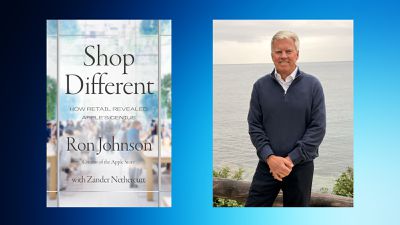
Johnson and writer Zander Nethercutt have teamed up for a new book entitled Shop Different: How Retail Revealed Apple's Genius, releasing next Tuesday, September 22, and I recently had a chance to read through the book and chat with Johnson about it.
Shop Different covers Johnson's background including his time at department store Mervyn's and at Target, but the bulk of the book unsurprisingly focuses on his work at Apple as his biggest success story and a topic of significant interest for legions of Apple fans and others in the business world and beyond.
Johnson started at Apple on February 1, 2000, and he worked hand-in-hand with Jobs and other Apple executives to develop a vision and buildout plan for Apple retail stores, leading to the opening of the company's first two stores in May 2001.
While Apple retail stores have become iconic landmarks and sought-after mall anchors in over 20 countries around the world, their success was not always a given, and Shop Different goes into detail on the trials and tribulations of developing the first stores and their weak early performance, struggles that ultimately gave way to the massive success that the stores have achieved.
Some of the high-level background of the Apple retail development process, including how Apple built out a full-scale store mockup in a Cupertino warehouse, has long been known, but Johnson dives into much more detail on how everything played out. Johnson describes early meetings with Jobs as they discussed the philosophy behind delving directly into retail, the challenges of securing prime real estate, Jobs' initial reaction to Johnson's proposed "Genius Bar" name for the stores' support services, and much more.
In the latter portions of Shop Different, Johnson shares some touching moments from his interactions with Jobs as pancreatic cancer took its toll on the Apple founder, as well as Johnson's transition to CEO of department store JCPenney, a difficult period amid Jobs' decline and death, misgivings about leaving Apple to take on the new role, and ultimately his inability to achieve success turning JCPenney's fortunes around.
In talking with Johnson, I asked whether he felt the evolution of Apple retail since his departure fifteen years ago has remained true to the vision he and Jobs had from the beginning, across several different retail chiefs with varying backgrounds.
You know, really, honestly, I do. I'm very impressed.
And part of it goes back to, when we launched the stores, Tim and Deirdre were involved on the operations side. I tell a story in the book where Steve said, you know, "What are the ten things you need to do well?" And one of those was inventory...inventory management. Well, Deirdre kind of led the team that managed the inventory. And so she was involved with the stores before we opened our first one.
And so when the stores got back to her leadership, I think there was a little a difficult period after I left, it took a little while, but now I think the stores are really fulfilling, fabulously well, the initial mission and vision we had for the stores. You know, so I'm really impressed.
Among the highlights for Johnson are Apple's ongoing focus on improving the quality, size, and locations of stores to reflect the caliber of the brand, rather than focusing on overall store count, and how Apple has maintained a high standard for its "exceptional" retail employees, some of whom have been with the company for many years.
As a follow-up, I asked Johnson about his thoughts on the succession of Apple retail chiefs that followed him, given the range of backgrounds they had with John Browett coming out of British consumer electronics retailer Dixons, Angela Ahrendts coming from the luxury fashion world at Burberry, and in recent years longtime Apple executive Deirdre O'Brien.
You know, I was the first retailer at Apple. And I built the initial team and, we relied a lot on other Apple departments, but fundamentally, I think Tim felt that he's got to find a retail leader to run the stores, right?
And so he started out with an operations leader, but obviously that led to a pretty quick change, because the stores were never about, sure, it's important how you operate, but it's really about a culture of love and connection, and you've got to have someone who will embrace that, right?
And then you went to Angela, who was a highly respected retail leader. But I think after Angela left, which was nearing the 20th anniversary of the stores, he kind of concluded, I think, that maybe an internal person who really understands Apple could be a great leader of the stores.
She's been there from the beginning, so I think Tim made the decision to really make sure the stores were highly integrated, connected with Apple as a company. Because it's pretty easy for them to be on their own doing their own thing. But once you bring in someone like Deirdre, who has managed the People teams, has managed at Apple, has managed a lot of the operations teams at Apple, you'll get a different level of connectivity to Apple itself.
And I think that was probably one of the big strengths Deirdre brought to the retail stores, was her knowledge of Apple headquarters. And she was able to, as an example, bring in a lot of talented people to retail who came out of other parts of Apple. Whereas before that, you'd hire, like, Angela probably hires someone from the outside that she worked with in retail.
Johnson also had particularly kind words for Vanessa Trigub, who was named to a vice president role last year to head up retail operations under O'Brien, with Johnson calling her a "fabulous leader" who "has a great vision for how to serve customers."
My conversation with Johnson took place a few days prior to last week's unveiling of the iPhone Duo, but he acknowledged the rumors about the device and mentioned the role Apple retail will play in allowing customers to experience the new product category.
What a great opportunity when this new, supposedly foldable phone comes out. Now, I think the stores will be more crowded during September and October. They'll be more crowded than in years. Because, remember, one to two billion people that are on iPhones, that use them every day.
And even if you're not going to buy the new one, you want to go see it, right? Because it is a major new form factor that would change your experience of using it. So I think that's what the stores were built for, is to help launch new products and I expect the stores to be incredibly busy.
Shop Different: How Retail Revealed Apple's Genius is available for pre-order now through Amazon and other book retailers, and it launches on Tuesday, September 22.