First Benchmarks for MacBook Pro With New Radeon Pro Vega Graphics Surface
Apple last week introduced new upgrade options for the high-end 15-inch MacBook Pro, allowing customers to add Radeon Pro Vega 16 and 20 graphics cards to the device for superior graphics performance.
Benchmarks for the 15-inch MacBook Pro models equipped with the Radeon Pro Vega 20 option have been shared by a MacRumors reader, giving us an idea of the performance improvements over 15-inch MacBook Pro models with the standard Radeon Pro 560X graphics card that was previously the highest-end option available.
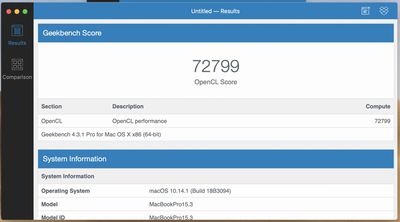
The machine, which includes a 2.6GHz Core i7 Intel processor, a Radeon Pro Vega 20 graphics card, 16GB RAM, and a 1TB SSD, earned an OpenCL score of 72799. Additional benchmarks found on Geekbench with a similar machine using an upgraded Core i9 processor demonstrated OpenCL scores of 75817, 76017, and 80002.
In a separate benchmark uploaded to Geekbench, the new high-end MacBook Pro with Core i9 processor also earned a Metal score of 73953.
Comparatively, machines with similar specs and Radeon Pro 560X graphics cards on Geekbench earned maximum OpenCL scores of right around 65000 and Metal scores of approximately 57000, suggesting much higher graphics performance with the new Radeon Pro Vega 20 card.
At the current time, benchmarks are only available for the higher-end Radeon Pro Vega 20 card, with no data available for the Radeon Pro Vega 16 card. CPU benchmarks on Geekbench between machines using the new cards and the existing cards are similar because there have been no changes to the CPU.
The new Radeon Pro Vega graphics cards can only be added to the high-end 15-inch MacBook Pro model, which starts at $2,799. The Radeon Pro Vega 16 costs an additional $250, while the Radeon Pro Vega 20 costs an additional $350.
Popular Stories
Apple today confirmed to Reuters that it has acquired Q.ai, an Israeli startup that is working on artificial intelligence technology for audio.
Apple paid close to $2 billion for Q.ai, according to sources cited by the Financial Times. That would make this Apple's second-biggest acquisition ever, after it paid $3 billion for the popular headphone and audio brand Beats in 2014.
Q.ai has...
Apple today introduced its first two physical products of 2026: a second-generation AirTag and the Black Unity Connection Braided Solo Loop for the Apple Watch.
Read our coverage of each announcement to learn more:Apple Unveils New AirTag With Longer Range, Louder Speaker, and More
Apple Introduces New Black Unity Apple Watch BandBoth the new AirTag and the Black Unity Connection Braided...
Alongside iOS 26.2.1, Apple today released an updated version of iOS 12 for devices that are still running that operating system update, eight years after the software was first released.
iOS 12.5.8 is available for the iPhone 5s and the iPhone 6, meaning Apple is continuing to support these devices for 13 and 12 years after launch, respectively. The iPhone 5s came out in September 2013,...
Update: Apple Creator Studio is now available.
Apple Creator Studio launches this Wednesday, January 28. The all-in-one subscription provides access to the Final Cut Pro, Logic Pro, Pixelmator Pro, Motion, Compressor, and MainStage apps, with U.S. pricing set at $12.99 per month or $129 per year.
A subscription to Apple Creator Studio also unlocks "intelligent features" and "premium...
On an earnings call with equity analysts today, Apple CEO Tim Cook responded to fast-rising RAM and SSD storage chip prices in the supply chain.
Prices for RAM and NAND storage chips are surging lately due to high demand from companies building out AI servers, resulting in supply constraints.
Cook said that rising memory chip prices had a "minimal impact" on Apple's gross margin in the...