'The One Device' Explores the Creation of the iPhone, the Technology That Went Into It, and More

As we noted last week, today marks the release of The One Device: The Secret History of the iPhone, a new book from Motherboard editor Brian Merchant chronicling the development of the original iPhone. I've had a chance to read through the book before its launch, and overall it's an entertaining read, although it comes up a bit short in its promise to unveil the secret history of the landmark device.
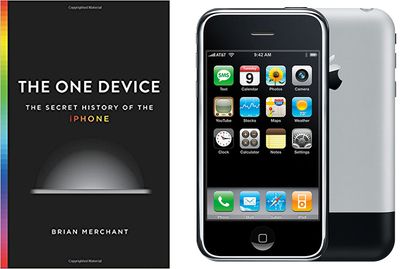
the one device secret history iphone book
The One Device is really a book in two parts, and the part directly covering the development of the original iPhone is actually only about 30 percent of the book, broken up into four chapters interspersed throughout. The remainder of the book covers topics that are related to the iPhone, but which are in most cases separate from the direct early iPhone history.

In the four chapters that cover the development of the iPhone, Merchant weaves together his own interviews with a number of engineers who worked on the original iPhone with tidbits and quotes pulled from other sources such as executives' testimony in the Samsung trial, Walter Isaacson's Steve Jobs, and Brett Schlender and Rick Tetzeli's Becoming Steve Jobs. Many of the members of the original iPhone team have left Apple over the past ten years, so some of those key former employees including Bas Ording, Richard Williamson, Imran Chaudhri, and the colorful Andy Grignon were willing to talk to Merchant about their time working on the project.

There are some interesting details about early work on multi-touch inspired by Wayne Westerman's FingerWorks technology that was eventually acquired by Apple, Steve Jobs' obsession with secrecy on the project that led to the team winning an internal "innovation award" at Apple's annual "Top 100" retreat even though the project they working on couldn't be revealed to the those in attendance, and the trials and tribulations faced by the small initial team working under signifiant pressure.

"That project broke all of the rules of product management," a member of the original iPhone group recalls. "It was the all-star team — it was clear they were picking the top people out of the org. We were just going full force. None of us had built a phone before; we were figuring it out as we went along. It was the one time it felt like design and engineering were working together to solve these problems. We'd sit together and figure it out. It's the most influence over a product I've ever had or ever will have."

The "secret history" outlined in these chapters feels a bit on the light side, and it left me wishing Merchant could have dug into more detail on it. That's understandably a difficult task given Apple's penchant for secrecy that keeps many of those with direct knowledge off limits and others who were able to talk still limited in what they felt comfortable disclosing, but I was still hoping for a bit more.

The bulk of the book covers topics that are more ancillary to the iPhone's development, areas such as raw material mining in Bolivia and Chile, working conditions in Foxconn's Chinese facilities, and some of the additional history on multi-touch. Background on ARM processors, lithium-ion battery technology, and Corning's Gorilla Glass help to fill things out, while a fairly extensive interview with Tom Gruber, one of the founders of Siri, helps the reader understand where Apple's personal assistant came from.

Merchant spices up these chapters with his own first-hand experiences gained by traveling to many of the locations, offering not only vivid descriptions of the locations themselves but also in-person interviews with some of the innovators responsible for the technological leaps that eventually enabled the development of the iPhone.

Overall, the book reveals only a few new tidbits and insights on the actual creation of the iPhone, but it's still interesting to hear some of these details shared directly by those who were there. Combine those stories with the background chapters on many of the components and technologies that have made their way into the iPhone, and for those reasons alone The One Device is a worthy read. It's a nice overview for those who may not be steeped in the history of Apple and its devices, but it left me wishing for more depth in the areas that mattered most.

The One Device: The Secret History of the iPhone launches today and is available from Amazon, the iBooks Store [Direct Link], and other retailers.

Popular Stories

iPhone Top Left Hole Punch Face ID Feature Purple

iPhone 18 Pro Launching Later This Year With These 12 New Features

Thursday January 15, 2026 10:56 am PST by
While the iPhone 18 Pro and iPhone 18 Pro Max are not expected to launch for another eight months, there are already plenty of rumors about the devices. Below, we have recapped 12 features rumored for the iPhone 18 Pro models, as of January 2026: The same overall design is expected, with 6.3-inch and 6.9-inch display sizes, and a "plateau" housing three rear cameras Under-screen Face ID...


Apple MacBook Pro M4 hero

These 5 Apple Products Will Reportedly Be Upgraded With OLED Displays

Friday January 16, 2026 7:07 pm PST by
Apple plans to upgrade the iPad mini, MacBook Pro, iPad Air, iMac, and MacBook Air with OLED displays between 2026 and 2028, according to DigiTimes. Bloomberg's Mark Gurman previously reported that the iPad mini and MacBook Pro will receive an OLED display as early as this year, but he does not expect the MacBook Air to adopt the technology until 2028 at the earliest. A new iPad Air is...
Apple Wallet ID Illinois

Apple Plans to Expand iPhone Driver's Licenses to These 7 U.S. States

Friday January 16, 2026 12:12 pm PST by
In select U.S. states, residents can add their driver's license or state ID to the Apple Wallet app on the iPhone and Apple Watch, and then use it to display proof of identity or age at select airports and businesses, and in select apps. The feature is currently available in 13 U.S. states and Puerto Rico, and it is expected to launch in at least seven more in the future. To set up the...
iOS 27 Mock Quick

iOS 27 Will Add These 8 New Features to Your iPhone

Sunday January 18, 2026 3:51 pm PST by
iOS 27 is still many months away, but there are already plenty of rumors about new features that will be included in the software update. The first beta of iOS 27 will be released during WWDC 2026 in June, and the update should be released to all users with a compatible iPhone in September. Bloomberg's Mark Gurman said that iOS 27 will be similar to Mac OS X Snow Leopard, in the sense...
14 inch MacBook Pro Keyboard

MacBook Pro Buyers Now Facing Up to a Two-Month Wait Ahead of New Models

Sunday January 18, 2026 6:50 pm PST by
MacBook Pro availability is tightening on Apple's online store, with select configurations facing up to a two-month delivery timeframe in the United States. A few 14-inch and 16-inch MacBook Pro configurations with an M4 Pro chip are not facing any shipping delay, but estimated delivery dates for many configurations with an M4 Max chip range from February 6 to February 24 or even later. At...

Top Rated Comments

djcerla Avatar
112 months ago
Basically, another remix of widely known facts about the iPhone, spiced up with some bashing about mining, working conditions in China and "low-tech" Schiller.

But a masterpiece in PR and teasing.
Score: 7 Votes (Like | Disagree)
adamneer Avatar
112 months ago
I don't really understand how they intend this book to be taken seriously with such a terrible cover.
Score: 6 Votes (Like | Disagree)
MyopicPaideia Avatar
112 months ago
Thanks for the honest review, and helping me in not wasting money on this. No involved Apple fan needs a rehash of stuff they already know :p
Score: 3 Votes (Like | Disagree)
kdarling Avatar
112 months ago
The preview reminded me of 'The Soul of a New Machine', ca 1980, a recommended read.
"The Soul of a New Machine" won a Pulitzer, and is indeed a must read for engineers and anyone else who wants to know what it's really like creating a new product, with horrible deadlines, and with marketing coming in and messing with your original clean design :)

It would be wonderful if the same author did a story on the iPhone; it would be a tense compelling read, one that would make sense to engineers / designers, and yet also explained to the layman.

---
OTOH, from the excerpts of this new book, it feels like this author doesn't have the background to be able to pick out what really happened. After all, most of the people who worked on it were kept separated (UI people never saw the device, and hardware people never saw the UI), so most people's memories will be like blind men describing an elephant, or even things they heard from someone else.

He also mashes events together, and seems to overly simplify important details. e.g.
"(Jobs) considered having Apple buy its own bandwidth and become its own mobile virtual network operator, or MVNO."
More than just considered. Jobs hired outside experts to help him approach Cingular in mid 2005 about setting up Apple as an MVNO and selling full service at $49 a month. Cingular saw it as too risky and refused Jobs' idea. - Project Vogue ('https://www.forbes.com/sites/petercohan/2013/09/10/project-vogue-inside-apples-iphone-deal-with-att/#1efee8404d3c')

Apple approached Verizon, but the two companies were unable to ink a deal; telecoms still wanted too much control over how a handset was designed.
Apple approached Verizon in mid 2005 about selling a new phone, but Verizon saw no benefit in Apple taking away customer relationships that Verizon considered important ('https://usatoday30.usatoday.com/tech/news/2007-01-28-verizon-iphone_x.htm'), like the ability to sell through Verizon's retail partners (which ironically has happened since then).

An executive at Cingular, meanwhile, began to cobble together an alternative deal Jobs might actually embrace: Give Cingular exclusivity, and we’ll give you complete freedom over the device."
In fact, it would take more than an year... until mid 2006... before Apple figured out how to entice Cingular with more realistic numbers and benefits as a device that would improve customer revenue and lessen churn.

In short, with nothing to demo until the end of 2006, nobody was clamoring (yet) to sell an unknown Apple phone. Especially after seeing the 2005 ROKR "iTunes Phone", which Jobs had crippled by limiting it to 100 songs so it would not compete with the iPod. Apple really had no choice by mid-2006 but to do whatever AT&T wanted, including an exclusive. Apple likes to paint it as if they came out on top, but AT&T has said they think ('http://appleinsider.com/articles/07/01/15/apple_cingular_claim_victory_over_eachother_say_more_iphones_in_queue.html') Apple gave up much more.

Still, I'm going to get a copy of the book, in hopes of picking out new tidbits of info.
Score: 2 Votes (Like | Disagree)
rodgersmc Avatar
112 months ago
Most books and researcher projects - excluding experimental sciences - are "rehashes." I'm not sure I get the complaint by the reviewer or comments here. You're right, the information is out there, but as a curious reader and sometimes Apple fan, I'd rather it be compiled into a readable narrative than spend my time digging around in forums and old articles on the internet...

I'll be reading it.
Score: 2 Votes (Like | Disagree)
WildCowboy Avatar
112 months ago
Don't waste your money. If you look up Phil and Tony's twitter accounts, they already are saying that a bunch of it never happened. And the writer basically replied with "Thats just what I heard". Capitalizing on alternative facts ;)
Actually, the writer said he has the recording of Tony saying exactly what was in the book, verbatim. Tony seems to be trying to backpedal on his quote in the book now that he sees how it looks on paper, but he hasn't explained why he's now saying his own words are "not true."
Score: 1 Votes (Like | Disagree)