RIM Launches Next-Generation BlackBerry Z10, Announces Corporate Rebranding
Research in Motion today announced its next-generation smartphone, the Z10. RIM also announced a corporate rebranding, officially changing the name of the company to BlackBerry.
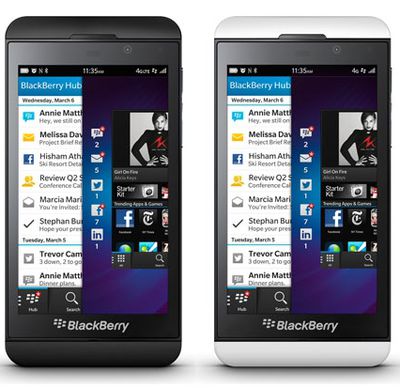
All four U.S. carriers are expected to carry the Z10, shipping in March and starting at $199 with a two-year contract. Walt Mossberg, reviewing the Z10 for the Wall Street Journal, notes that a physical keyboard-equipped Q10 model is due in April as well. He notes that in "moderate to heavy use", the battery didn't last as long as a charge on an iPhone 5 in similar usage, but he did have some praise for the device.
BlackBerry has always leaned heavily on its physical keyboard, and, according to Mossberg, the virtual keyboard on the Z10 shines as well:
The Z10 keyboard is the best and fastest out-of-the-box virtual keyboard I’ve used. Master BlackBerry thumb typists might not find it as fast as the traditional physical keyboard, but, for a one-finger typist like me, it was faster and more accurate than either the native keyboards on the iPhone or Android. This is partly because it features predictive typing. It displays words that are likely to come next right above the rows of letters, and lets you flick these words upward into the text you’re composing. It learns what mistakes you typically make in hitting letters, and adjusts. And it learns words and abbreviations you frequently use, even proper names.
The company promises 70,000 apps at launch, including staples like Facebook, Twitter, Angry Birds, MLB, and more. Many notable apps are missing however, including Pandora, Spotify and Netflix.
The Z10 comes with a 4.2" 1280x768 display, giving it a higher pixel density than the iPhone 5; an 8 megapixel rear camera; 16GB capacity only, but includes a card slot for storage upgrades; available in white or black; a removable battery; and LTE support, though Mossberg got extremely poor data speeds on AT&T and RIM couldn't explain why.
Popular Stories
Apple is planning to launch new MacBook Pro models as soon as early March, but if you can, this is one generation you should skip because there's something much better in the works.
We're waiting on 14-inch and 16-inch MacBook Pro models with M5 Pro and M5 Max chips, with few changes other than the processor upgrade. There won't be any tweaks to the design or the display, but later this...
Wednesday February 11, 2026 10:07 am PST by
Juli CloverApple today released iOS 26.3 and iPadOS 26.3, the latest updates to the iOS 26 and iPadOS 26 operating systems that came out in September. The new software comes almost two months after Apple released iOS 26.2 and iPadOS 26.2.
The new software can be downloaded on eligible iPhones and iPads over-the-air by going to Settings > General > Software Update.
According to Apple's release notes, ...
It has been a slow start to 2026 for Apple product launches, with only a new AirTag and a special Apple Watch band released so far. We are still waiting for MacBook Pro models with M5 Pro and M5 Max chips, the iPhone 17e, a lower-cost MacBook with an iPhone chip, long-rumored updates to the Apple TV and HomePod mini, and much more.
Apple is expected to release/update the following products...
Apple plans to announce the iPhone 17e on Thursday, February 19, according to Macwelt, the German equivalent of Macworld.
The report said the iPhone 17e will be announced in a press release on the Apple Newsroom website, so do not expect an event for this device specifically.
The iPhone 17e will be a spec-bumped successor to the iPhone 16e. Rumors claim the device will have four key...
Apple acquired Canadian graph database company Kuzu last year, it has emerged.
The acquisition, spotted by AppleInsider, was completed in October 2025 for an undisclosed sum. The company's website was subsequently taken down and its Github repository was archived, as is commonplace for Apple acquisitions.
Kuzu was "an embedded graph database built for query speed, scalability, and easy of ...