In 1987, Apple produced a concept video demonstrating a future computer called the Knowledge Navigator. The tablet-like device offered the user a natural language interface, video conferencing, multi-touch display and access to a global network of information.
While seemingly the product of an overactive imagination, Apple's recent acquisition of Siri brings Apple a lot closer to that vision than ever before. Siri reportedly was born from the CALO artificial intelligence project which sought to fulfill a call for a "a cognitive computer system should be able to learn from its experience, as well as by being advised."
Apple's value in acquiring Siri appears to be focused on this personal assistance technology. Siri describes their technology:
Virtual Personal Assistants (VPAs) represent the next generation interaction paradigm for the Internet. In today's paradigm, we follow links on search results. With a VPA, we interact by having a conversation. We tell the assistant what we want to do, and it applies multiple services and information sources to help accomplish our task. Like a real assistant, a VPA is personal; it uses information about an individual's preferences and interaction history to help solve specific tasks, and it gets better with experience.
In fact, Siri's Chief Technology Officer Tom Gruber uses Apple's Knowledge Navigator video in his keynote and describes it as a "brilliant piece of vision work":
Gruber demos Siri and how it can accomplish tasks using a conversational interface and apply context to provide useful and personalized interactions. He also walks through what's possible today and how close we are getting. Given Apple's acquisition of the company (and presumably Tom Gruber), the talk is of particular relevance to Apple's future plans.
Apple is planning to debut a high-end secondary version of AirPods Pro 3 this year, sitting in the lineup alongside the current model, reports suggest.
Back in September 2025, supply chain analyst Ming-Chi Kuo reported that Apple is planning to introduce a successor to the AirPods Pro 3 in 2026. This would be somewhat unusual since Apple normally waits around three years to make major...
Sunday January 18, 2026 3:51 pm PST by Joe Rossignol
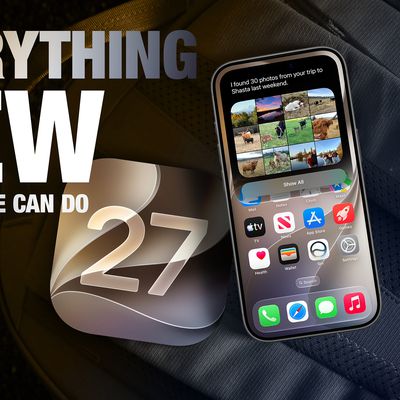
iOS 27 is still many months away, but there are already plenty of rumors about new features that will be included in the software update.
The first beta of iOS 27 will be released during WWDC 2026 in June, and the update should be released to all users with a compatible iPhone in September.
Bloomberg's Mark Gurman said that iOS 27 will be similar to Mac OS X Snow Leopard, in the sense...
Sunday January 18, 2026 6:50 pm PST by Joe Rossignol
MacBook Pro availability is tightening on Apple's online store, with select configurations facing up to a two-month delivery timeframe in the United States.
A few 14-inch and 16-inch MacBook Pro configurations with an M4 Pro chip are not facing any shipping delay, but estimated delivery dates for many configurations with an M4 Max chip range from February 6 to February 24 or even later. At...
Tuesday January 20, 2026 2:34 am PST by Tim Hardwick
Over the last few months, rumors around the iPhone 18 Pro's front-panel design have been conflicted, with some supply-chain leaks pointing to under-display Face ID, reports suggesting a top-left hole-punch camera, and debate over whether the familiar Dynamic Island will shrink, shift, or disappear entirely.
Today, Weibo-based leaker Instant Digital shared new details that appear to clarify the ...
Thursday January 15, 2026 10:56 am PST by Joe Rossignol
While the iPhone 18 Pro and iPhone 18 Pro Max are not expected to launch for another eight months, there are already plenty of rumors about the devices.
Below, we have recapped 12 features rumored for the iPhone 18 Pro models, as of January 2026:
The same overall design is expected, with 6.3-inch and 6.9-inch display sizes, and a "plateau" housing three rear cameras
Under-screen Face ID...
should be noted that the knowledge navigator pre-dated the "world wide web" and most of the internet. Mosaic (first web browser) was released in 1993. so it was a pretty remarkable vision at the time.