Google to Pay $22.5 Million Settlement in Safari Privacy Circumvention Case
In line with last month's report on negotiations between Google and the U.S. Federal Trade Commission (FTC) over the company's circumvention of privacy settings in Safari, the FTC has officially announced that Google has agreed to pay a record $22.5 million penalty to settle the case.
The settlement is part of the FTC’s ongoing efforts make sure companies live up to the privacy promises they make to consumers, and is the largest penalty the agency has ever obtained for a violation of a Commission order. In addition to the civil penalty, the order also requires Google to disable all the tracking cookies it had said it would not place on consumers’ computers.
“The record setting penalty in this matter sends a clear message to all companies under an FTC privacy order,” said Jon Leibowitz, Chairman of the FTC. “No matter how big or small, all companies must abide by FTC orders against them and keep their privacy promises to consumers, or they will end up paying many times what it would have cost to comply in the first place.”
Google took advantage of a loophole in Safari's privacy settings designed to prevent placement of third-party cookies by default, using invisible web forms to trick Safari into thinking that users had interacted with Google's ads and thus allowing cookies to be placed on the device.
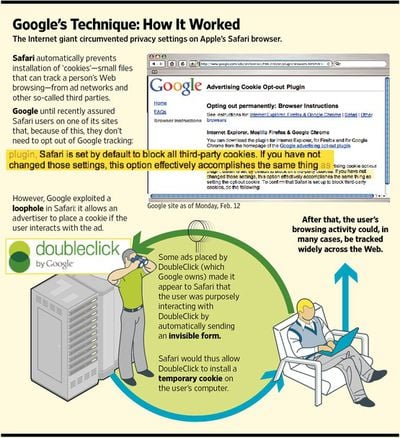
The FTC specifically charged Google with violating an October 2011 order related to a previous case of privacy violations. In the new Safari case, FTC commissioners voted 4-1 to approve the settlement, with the dissenting commissioner arguing against the settlement allowing Google to deny all liability related to the issue.

Popular Stories
Apple today shared an ad that shows how the upgraded Center Stage front camera on the latest iPhones improves the process of taking a group selfie.
"Watch how the new front facing camera on iPhone 17 Pro takes group selfies that automatically expand and rotate as more people come into frame," says Apple. While the ad is focused on the iPhone 17 Pro and iPhone 17 Pro Max, the regular iPhone...
In select U.S. states, residents can add their driver's license or state ID to the Apple Wallet app on the iPhone and Apple Watch, and then use it to display proof of identity or age at select airports and businesses, and in select apps.
The feature is currently available in 13 U.S. states and Puerto Rico, and it is expected to launch in at least seven more in the future.
To set up the...
Apple is planning to launch new MacBook Pro models as soon as early March, but if you can, this is one generation you should skip because there's something much better in the works.
We're waiting on 14-inch and 16-inch MacBook Pro models with M5 Pro and M5 Max chips, with few changes other than the processor upgrade. There won't be any tweaks to the design or the display, but later this...
Wednesday February 11, 2026 10:07 am PST by
Juli CloverApple today released iOS 26.3 and iPadOS 26.3, the latest updates to the iOS 26 and iPadOS 26 operating systems that came out in September. The new software comes almost two months after Apple released iOS 26.2 and iPadOS 26.2.
The new software can be downloaded on eligible iPhones and iPads over-the-air by going to Settings > General > Software Update.
According to Apple's release notes, ...
It has been a slow start to 2026 for Apple product launches, with only a new AirTag and a special Apple Watch band released so far. We are still waiting for MacBook Pro models with M5 Pro and M5 Max chips, the iPhone 17e, a lower-cost MacBook with an iPhone chip, long-rumored updates to the Apple TV and HomePod mini, and much more.
Apple is expected to release/update the following products...